
By Jonathan Martin, Maggie Haberman and Mike Baker from NYT U.S. https://nyti.ms/33Z7l9P


Jaya Kumari worked as a cook and cleaner for a couple in an affluent New Delhi neighborhood until two weeks ago. She lost her job when the family she worked for decided to leave the crowded capital and move to their hometown 200 miles away as the coronavirus began to spread in the city.
Then, on March 25, Prime Minister Narendra Modi announced a 21-day nationwide lockdown in response to the COVID-19 pandemic. Now Kumari and her husband, a taxi driver, are stuck indoors in New Delhi with no income and no way to earn money. “We will use up the little we have saved to get through this,” she says. “What happens after that, I leave it to God.”
Modi’s hasty announcement of the unprecedented lockdown gave hundreds of millions of Indians less than four hours to prepare. In an address to the nation, he said “Forget about leaving home for the next 21 days. If you cross the threshold of your house, you will invite the virus home.” It has thrown much of the country into chaos.
Modi assured Indians that essential services would continue, but was vague regarding how people would be able to buy food and other necessary items. As a result, people rushed to shops to stock up before the decree took effect. People were seen lining up outside stores late into the night and traffic congestion was reported from across the country.
The lockdown has also triggered a massive exodus of migrant laborers and wage workers from cities back to the rural villages they are from—where many won’t have to pay rent and food is cheaper. Many migrants were seen defying the curfew. Some have told news outlets that they are walking up to 500 miles to get back home. Videos of chaotic scenes at train stations showed people struggling to get on their last train home, some crying uncontrollably as they missed them. Overcrowding at public transport stations have raised concerns about further spread of the virus. Modi later apologized for the hardships caused by the lockdown, but said the measures were necessary.
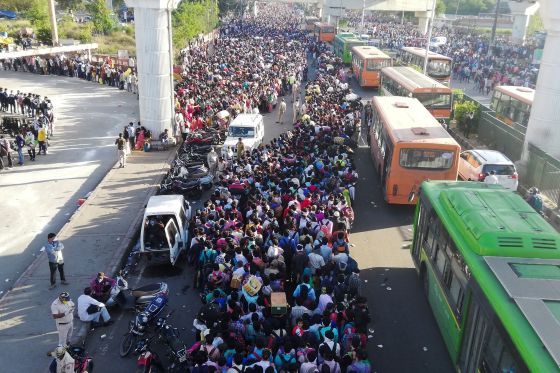
Mass congregations like this carry the risk of spreading COVID-19 even further, says Oommen C. Kurian, head of the health initiative at the Observer Research Foundation, an independent think-tank based in New Delhi. He worries that migrants might carry the virus to rural areas, where health infrastructure is weak, or even non-existent.
“The lack of clear risk communication from top leadership and mixed messages from across the system spooked the poorer migrants who chose to start uncertain journeys,” Kurian says. “The exodus of migrants may have spread out the virus far and wide, adding another layer to India’s problems.”
Most experts agree that a lockdown in India is necessary to contain the spread of COVID-19. A
As of March 30, India has reported more than 1,200 cases of COVID-19. Given its densely populated cities, experts worry that the country’s fragile health system will not be able to adequately respond to a spike in cases. So far, India has administered more than 38,000 tests. While the country initially faced criticism for its low testing numbers, the number of tests has been ramped up in the days following the lockdown. Experts say India should use the time bought by the lockdown to test more and find and contain hotspots.
“Prevention is a stronger strategy, given the acute shortage of hospital beds, ventilators and protective gear,” says Shamika Ravi, Director of Research at Brookings India, referring to the need for a lockdown. “To understand how this will play out after the lockdown, we need to get more aggressive with testing.”
But for the majority of Indians, social distancing is a luxury they can’t afford. Many face hunger and starvation in the absence of daily wages that have been disrupted as the world’s seventh-largest economy grinds to a halt. On March 26, India announced a $22.5 billion relief package to help the country’s poorest people sustain and feed themselves. The government plans to use existing welfare schemes to roll out the relief measures, which include free food distribution and cash transfers to millions of low-income families across the country.
As part of the relief measures, low-wage earners like Kumari will get 500 rupees (less than $7) per month for the next three months. That’s a fraction of the 4,000 rupees ($53) she was making before she lost her job. As of now, her husband is not eligible for any of the measures announced as his income doesn’t qualify him as the “poorest of the poor” covered by government assistance. Kumari worries that the money from the government will not be enough to feed her family of four if the lockdown continues.
Most of those who come under the purview of the new scheme belong to India’s massive informal economy, which employs about 424 million Indians, some 90% of the workforce, according to data from the country’s finance ministry. That’s a population greater than the combined size of the U.S., the U.K. and Australia. Auto rickshaw drivers, milkmen, vendors who sell vegetables and snacks from carts are all part of this economy, Most live on daily wages, do not receive any benefits and work jobs that do not exist on paper.
“This crisis shines a torch on the fragilities of the Indian economy that must be attended to,” says Samir Saran, president of Observer Research Foundation. He praises the government’s decision to use existing welfare schemes for the poor to provide immediate relief, but says much more will need to be done when the full implications of the lockdown become apparent.
“These immediate measures are only intended to blunt the worst short-term effects and should not be thought of as a stimulus,” he adds.
To make matters worse, India’s economy was already struggling—with slumping growth and rising unemployment. Even some businesses that are thriving elsewhere in the world are hampered in India.
For instance, Mumbai’s famous dabbawalas (lunch box carriers), have worked rain or shine to deliver people’s home-cooked lunches to their offices, schools and colleges for almost 130 years. They have braved heavy floods and terrorist attacks, but services were halted due to coronavirus even before the lockdown was announced, forcing 5,000 delivery men to stay at home.
“Even if we resume operations, it will be pointless because everyone is staying at home,” says Subhash Gangaram Talekar, president of Mumbai Dabbawala Association, referring to how dabbawalas have been affected even as food delivery services around the world are surging in popularity at the moment. “Who will we deliver the dabbas [lunch boxes] to?”
But shutting down a country like India for longer periods will be difficult, given the poverty levels prevalent across the country, says Suyash Rai, a fellow at Carnegie India, an international center for the Carnegie Endowment for International Peace. With so many livelihoods disrupted, he believes that the government might struggle to keep the country’s poor afloat.
“There is the question of where the government is going to get the money to keep the country running in case of an extension [of the lockdown,]” Rai says. “It is important to identify the hotspots during this lockdown and reopen the remaining parts of the economy while finding ways to work within this COVID world.”
For many, waiting out what could be a miserable, prolonged crisis is the only option.
Prakash, who goes only by his first name, is an autorickshaw driver in Thiruvananthapuram in the southern Indian state of Kerala. His daily income started seeing a dip two weeks before the lockdown was announced. Kerala was the first state in India to report cases of COVID-19 and panic set in long before it spread to other parts of the country. Before the outbreak, he was concerned with paying for his son’s college expenses. But, as he stays at home with no daily income, his main concern is putting food on the table. He estimates his savings can last for a month. After that, he’s not sure what he will do.
“The virus doesn’t worry me as much as the uncertainty that waits on the other side of this crisis.”
Please send tips, leads, and stories from the frontlines to virus@time.com.


Jaya Kumari worked as a cook and cleaner for a couple in an affluent New Delhi neighborhood until two weeks ago. She lost her job when the family she worked for decided to leave the crowded capital and move to their hometown 200 miles away as the coronavirus began to spread in the city.
Then, on March 25, Prime Minister Narendra Modi announced a 21-day nationwide lockdown in response to the COVID-19 pandemic. Now Kumari and her husband, a taxi driver, are stuck indoors in New Delhi with no income and no way to earn money. “We will use up the little we have saved to get through this,” she says. “What happens after that, I leave it to God.”
Modi’s hasty announcement of the unprecedented lockdown gave hundreds of millions of Indians less than four hours to prepare. In an address to the nation, he said “Forget about leaving home for the next 21 days. If you cross the threshold of your house, you will invite the virus home.” It has thrown much of the country into chaos.
Modi assured Indians that essential services would continue, but was vague regarding how people would be able to buy food and other necessary items. As a result, people rushed to shops to stock up before the decree took effect. People were seen lining up outside stores late into the night and traffic congestion was reported from across the country.
The lockdown has also triggered a massive exodus of migrant laborers and wage workers from cities back to the rural villages they are from—where many won’t have to pay rent and food is cheaper. Many migrants were seen defying the curfew. Some have told news outlets that they are walking up to 500 miles to get back home. Videos of chaotic scenes at train stations showed people struggling to get on their last train home, some crying uncontrollably as they missed them. Overcrowding at public transport stations have raised concerns about further spread of the virus. Modi later apologized for the hardships caused by the lockdown, but said the measures were necessary.
Mass congregations like this carry the risk of spreading COVID-19 even further, says Oommen C. Kurian, head of the health initiative at the Observer Research Foundation, an independent think-tank based in New Delhi. He worries that migrants might carry the virus to rural areas, where health infrastructure is weak, or even non-existent.
“The lack of clear risk communication from top leadership and mixed messages from across the system spooked the poorer migrants who chose to start uncertain journeys,” Kurian says. “The exodus of migrants may have spread out the virus far and wide, adding another layer to India’s problems.”
Most experts agree that a lockdown in India is necessary to contain the spread of COVID-19. A
As of March 30, India has reported more than 1,200 cases of COVID-19. Given its densely populated cities, experts worry that the country’s fragile health system will not be able to adequately respond to a spike in cases. So far, India has administered more than 38,000 tests. While the country initially faced criticism for its low testing numbers, the number of tests has been ramped up in the days following the lockdown. Experts say India should use the time bought by the lockdown to test more and find and contain hotspots.
“Prevention is a stronger strategy, given the acute shortage of hospital beds, ventilators and protective gear,” says Shamika Ravi, Director of Research at Brookings India, referring to the need for a lockdown. “To understand how this will play out after the lockdown, we need to get more aggressive with testing.”
But for the majority of Indians, social distancing is a luxury they can’t afford. Many face hunger and starvation in the absence of daily wages that have been disrupted as the world’s seventh-largest economy grinds to a halt. On March 26, India announced a $22.5 billion relief package to help the country’s poorest people sustain and feed themselves. The government plans to use existing welfare schemes to roll out the relief measures, which include free food distribution and cash transfers to millions of low-income families across the country.
As part of the relief measures, low-wage earners like Kumari will get 500 rupees (less than $7) per month for the next three months. That’s a fraction of the 4,000 rupees ($53) she was making before she lost her job. As of now, her husband is not eligible for any of the measures announced as his income doesn’t qualify him as the “poorest of the poor” covered by government assistance. Kumari worries that the money from the government will not be enough to feed her family of four if the lockdown continues.
<iframe title=”Countries with at least one reported case of COVID-19″ aria-label=”World choropleth map” src=”//datawrapper.dwcdn.net/eldaT/15/” scrolling=”no” frameborder=”0″ style=”border: none;” width=”655″ height=”496″></iframe>
Most of those who come under the purview of the new scheme belong to India’s massive informal economy, which employs about 424 million Indians, some 90% of the workforce, according to data from the country’s finance ministry. That’s a population greater than the combined size of the U.S., the U.K. and Australia. Auto rickshaw drivers, milkmen, vendors who sell vegetables and snacks from carts are all part of this economy, Most live on daily wages, do not receive any benefits and work jobs that do not exist on paper.
“This crisis shines a torch on the fragilities of the Indian economy that must be attended to,” says Samir Saran, president of Observer Research Foundation. He praises the government’s decision to use existing welfare schemes for the poor to provide immediate relief, but says much more will need to be done when the full implications of the lockdown become apparent.
“These immediate measures are only intended to blunt the worst short-term effects and should not be thought of as a stimulus,” he adds.
To make matters worse, India’s economy was already struggling—with slumping growth and rising unemployment. Even some businesses that are thriving elsewhere in the world are hampered in India.
For instance, Mumbai’s famous dabbawalas (lunch box carriers), have worked rain or shine to deliver people’s home-cooked lunches to their offices, schools and colleges for almost 130 years. They have braved heavy floods and terrorist attacks, but services were halted due to coronavirus even before the lockdown was announced, forcing 5,000 delivery men to stay at home.
“Even if we resume operations, it will be pointless because everyone is staying at home,” says Subhash Gangaram Talekar, president of Mumbai Dabbawala Association, referring to how dabbawalas have been affected even as food delivery services around the world are surging in popularity at the moment. “Who will we deliver the dabbas [lunch boxes] to?”
But shutting down a country like India for longer periods will be difficult, given the poverty levels prevalent across the country, says Suyash Rai, a fellow at Carnegie India, an international center for the Carnegie Endowment for International Peace. With so many livelihoods disrupted, he believes that the government might struggle to keep the country’s poor afloat.
“There is the question of where the government is going to get the money to keep the country running in case of an extension [of the lockdown,]” Rai says. “It is important to identify the hotspots during this lockdown and reopen the remaining parts of the economy while finding ways to work within this COVID world.”
For many, waiting out what could be a miserable, prolonged crisis is the only option.
Prakash, who goes only by his first name, is an autorickshaw driver in Thiruvananthapuram in the southern Indian state of Kerala. His daily income started seeing a dip two weeks before the lockdown was announced. Kerala was the first state in India to report cases of COVID-19 and panic set in long before it spread to other parts of the country. Before the outbreak, he was concerned with paying for his son’s college expenses. But, as he stays at home with no daily income, his main concern is putting food on the table. He estimates his savings can last for a month. After that, he’s not sure what he will do.
“The virus doesn’t worry me as much as the uncertainty that waits on the other side of this crisis.”
Please send tips, leads, and stories from the frontlines to virus@time.com.


(LONDON) — EasyJet says it is grounding its entire fleet of aircraft amid a collapse in demand due to the COVID-19 crisis.
The Luton-based carrier has parked all 344 of its planes, removing a significant cost as it copes with the impact of the virus.
EasyJet also says it has a strong balance sheet and is in “ongoing discussions with liquidity providers.’’ The budget carrier also announced it has reached an agreement with the Unite union on furlough arrangements for its cabin crew.
The announcement comes as Scottish regional airline Loganair said it expects to ask for a government bailout.
Britain’s government has so far demurred from creating a rescue package for aviation but has said it is ready for negotiations with individual firms once they had “exhausted other options.”

(DHAKA, Bangladesh) — Bangladesh garment manufacturers says fashion retailers have cancelled or put on hold more than $3 billion in orders due to the coronavirus outbreak, though a handful have agreed to pay anyway.
The data from the Bangladesh Garment Manufacturers and Exporters Association released Monday reflected both orders already made or in the works and planned orders from the country, which is the world’s second largest exporter of clothing after China.
The cancelled orders, according to reports to the BGMEA from manufacturers, included tens of millions in purchases from many big buyers, including European buyers C&A and Inditex, Primark of Ireland, Britain’s Marks & Spencer and Tesco and U.S. retailers like Walmart and Target.
Bangladesh is just beginning to feel the direct impact of the pandemic and its government has ordered a shut down of most businesses to help contain it. But shocks to the country’s export markets have been cascading into its economy for weeks.
A survey of factory owners in Bangladesh released Friday showed millions of Bangladesh factory workers being sent home without the wages or severance pay they are owed.
The BGMEA reported that $1.8 billion in orders have been put on hold and another $1.4 billion have been cancelled. Cancellations of planned orders, for April-December, amounted to nearly $1.7 billion, it said. The figures are conservative because they exclude orders that would go to multiple buyers.
The new data were incorporated into a report by Pennsylvania State University’s Center for Global Workers’ Rights and the Worker Rights Consortium, a Washington, D.C.-based labor rights organization,.
Bangladesh manufacturers and labor groups have been appealing to big retailers to honor their commitments to suppliers.
Sweden’s H&M has said it will pay suppliers for orders already under production.
PVH, which owns the Calvin Klein, Tommy Hilfiger and Heritage brands, has told suppliers it is releasing invoices that had been put on hold since March 18. Later invoices will gradually be processed.
The commitment for orders already under production or finished products not yet shipped would enable factory owners to get financing to tide them over, said a letter to suppliers seen by The Associated Press.
“PVH and H&M are doing the right thing, in contrast to the long list of brands refusing to pay for goods workers have already made for them,” said Scott Nova, executive director of the Worker Rights Consortium.
Big Western brands came under heavy pressure to improve conditions in factories after huge fires and other disasters killed hundreds of workers.
The store closures and other disruptions from the virus outbreak are straining a fragile supply chain in which big buyers have been squeezing their suppliers for years.
More than 1 million of the more than 4 million garment workers in Bangladesh already have lost their jobs or have been furloughed because of order cancellations and the failure of buyers to pay for canceled shipments.
___
AP Asia Business Editor Kurtenbach reported from Bangkok.

(TEHRAN, Iran) — Prisoners in southern Iran broke cameras and caused other damage during a riot, state media reported Monday, the latest in a series of violent prison disturbances in the country, which is battling the most severe coronavirus outbreak in the Middle East.
Iran had temporarily released around 100,000 prisoners as part of measures taken to contain the pandemic, leaving an estimated 50,000 people behind bars, including violent offenders and so-called “security cases,” often dual nationals and others with Western ties.
Families of detainees and Western nations say Iran is holding those prisoners for political reasons or to use them as bargaining chips in negotiations.
The state-run IRNA news agency quoted Gov. Enayatollah Rahimi of the southern Fars province as saying a riot broke out at Adel Abad Prison, the main lockup in the city of Shiraz. Rahimi said prisoners broke cameras and caused other damage in two sections housing violent criminals. No one was wounded and no one escaped.
IRNA reported Friday that 70 inmates had escaped Saqqez Prison in Iran’s western Kurdistan province. Prisoners beat guards during the chaos, a local prosecutor said. Several inmates later returned on their own to the prison.
Since the beginning of the year, riots have broken out in prisons in Aligudarz, Hamedan and Tabriz as well, with some prisoners escaping, IRNA reported.
Iran has reported more than 38,000 infections and 2,640 deaths from COVID-19, the illness caused by the coronavirus.
The virus causes mild symptoms, including fever and cough, in most patients, who recover within a few weeks. But it is highly contagious and can be spread by people showing no symptoms. It can also cause severe illness and death, particularly in older patients or those with underlying health problems.
The virus has infected more than 720,000 people worldwide, causing more than 34,000 deaths, according to data gathered by Johns Hopkins University. More than 150,000 have recovered.
Elsewhere in the region on Monday, Jordan began releasing thousands of travelers who were quarantined for the last two weeks at five-star hotels on the Dead Sea in order to prevent the spread of the virus.
More than 4,200 Jordanians and 1,500 foreigners have been held at the hotels. The Jordanians will be sent home via Uber, the popular ride-hailing service, and are requested to remain at home for another 14 days.
Travelers with other nationalities will be released on Tuesday. It was not immediately clear where they would go, but authorities said they would be in contact with their embassies and the Foreign Ministry.
Jordan has reported 259 infections and three deaths from the virus. At least 18 people have recovered.
Jordan halted all flights and closed its borders on March 16. It later imposed a round-the-clock curfew for three days, before providing limited times for people to shop for basic goods on foot.
___
Akour reported from Amman, Jordan. Associated Press writers Jon Gambrell in Dubai, United Arab Emirates, and Joseph Krauss in Jerusalem contributed to this report.


(TOKYO) — Before the Olympics were postponed, Japan looked like it had coronavirus infections contained, even as they spread in neighboring countries. Now that the games have been pushed to next year, Tokyo’s cases are spiking, and the city’s governor is requesting that people stay home, even hinting at a possible lockdown.
The sudden rise in the number of virus cases in Tokyo and the government’s strong actions immediately after the Olympic postponement have raised questions in parliament and among citizens about whether Japan understated the extent of the outbreak and delayed enforcement of social distancing measures while clinging to hopes that the games would start on July 24 as scheduled.
With the Olympics now off, many are voicing suspicion that the numbers are rising because Japan suddenly has no reason to hide them.
“In order to make an impression that the city was taking control of the coronavirus, Tokyo avoided making strict requests and made the number of patients look smaller,” former Japanese Prime Minister Yukio Hatoyama said in a tweet. “The coronavirus has spread while they waited. (For Tokyo Gov. Yuriko Koike) it was Olympics first, not Tokyo’s residents.”
Experts have found a rise of untraceable cases mushrooming in Tokyo, Osaka and other urban areas — signs of an explosive increase in infections.
Prime Minister Shinzo Abe said Saturday that Japan is now on the brink of a huge jump in cases as it becomes increasingly difficult to trace and keep clusters under control.
“Once infections overshoot, our strategy … will instantly fall apart,” Abe warned. “Under the current situation, we are just barely holding up.” He said a state of emergency is not needed just yet, but that Japan could at any time face a situation as bad as in the United States or Europe.
There was less of a sense of urgency displayed recently when many people visited parks for cherry blossom viewing, and Abe was only hinting at an Olympic postponement. But in a phone call with International Olympic Committee President Thomas Bach last Tuesday, Abe agreed to postpone the games until around the summer of 2021 because of the coronavirus pandemic.
A day later, Koike asked Tokyo residents to stay home weekends until mid-April, saying confirmed cases of the coronavirus had shot up to 41 in a day from 16 earlier in the week. On Saturday, Tokyo reported 63 new cases, another single-day record. Koike said that infections in Tokyo were on the brink of an explosive increase, and that stronger measures, including a lockdown, could be needed if the spread of the virus doesn’t slow.
”Is this just a coincidence?” Maiko Tajima, an opposition lawmaker from the Constitutional Democratic Party of Japan, said during a parliamentary session last Wednesday, citing Tokyo’s sudden spike.
Health Minister Katsunobu Kato said there is “absolutely no relationship” between the Olympic postponement and the number of confirmed cases. Abe cited experts as saying a big reason for the recent rise is the growing number of cases that can’t be linked and a jump in infections from abroad. The prime minister told people to “be prepared for a long battle.”
A day after Koike’s warning, Abe convened a new task force under a recently enacted special law that would allow him to declare a state of emergency in specific areas, including Tokyo.
Japan’s strategy has been to focus on clusters and trace infection routes rather than testing everyone. A guideline issued Saturday still says that tests will be conducted per clinical doctors’ advice. Experts set a high bar for testing eligibility, allowing them only for those linked to clusters or those with symptoms, because they fear massive testing will fill up beds that are needed for patients in severe need, and cause a collapse of medical systems.
From Feb. 18 to March 27, Japan tested about 50,000 people, a daily average of 1,270 — fewer than the national daily capacity of several thousand. There was only a slight increase in the number of tests in the past week. In Tokyo, fewer than 2% of those who sought advice on a government hotline had been tested, according to health ministry figures. South Korea, by contrast, had tested about 250,000 people by mid-March.
Abe denied allegations that Japan had manipulated the numbers by limiting tests, or combined COVID-19 deaths with other pneumonia fatalities. “I’m aware that some people suspect Japan is hiding the numbers, but I believe that’s not true,” he said. “If there is a cover-up, it will show up in the number of deaths.” He said doctors told him that pneumonia patients with COVID-19 can be detected by CAT-scan or X-rays.
Many Japanese experts say testing is not for everyone and should be conducted selectively in an attempt to save hospital beds for those who really need them. “Tests are primarily for people who are suspected of having the virus, and should be based on clinical judgment by doctors,” said Shigeru Omi, a former World Health Organization public health expert who is on the government-commissioned panel.
Aki-Hiro Sato, a professor of information sciences at Yokohama City University, said in a recent report that Japan is now likely facing a second or third wave of the virus coming from Europe and the United States. Tokyo has about 430 cases, but Sato estimated an additional 1,000 might have been infected in Tokyo by late March if infections are accelerating at a pace similar to what’s happening in other countries. Including asymptomatic or light infections, about 10,000 people might be infected, he said.
As of Sunday, Japan had 2,578 confirmed cases, including 712 from a cruise ship, with 64 deaths, according to the health ministry. About 1,000 have recovered.
Under the current law, COVID-19 is designated as an infectious disease and whoever tests positive is routinely hospitalized, but a new government guideline would allow a triage of patients, which would include self-quarantine at home.
Right now, Japan has 2,600 hospital beds designated for infectious disease treatment, including 118 in Tokyo, but about one-third of them are already occupied by COVID-19 patients, according to Satoshi Kutsuna of the Disease Control and Prevention Center. Citing the recent spike, Kutsuna said that an “overshooting of infections is just about to begin, unfortunately.”
Abe has said the government would secure 12,000 beds and 3,000 ventilators to prepare for a worst case scenario.
“We fear a situation where severe patients start dying when the medical system collapses, and we must prevent that situation,” Kato, the health minister, said Sunday on a talk show on public broadcaster NHK.


