
By Alexander Burns, Jonathan Martin and Maggie Haberman from NYT U.S. https://nyti.ms/3cKXeK1


Like most people, Jess spent a lot of time online during weeks of lockdown earlier this year. But the 36-year-old Australian wasn’t focused so much on playing Animal Crossing or watching Netflix. Instead, she found herself diving ever deeper into the Internet for information about QAnon.
Jess, who asked for her last name not to be used because her employer doesn’t allow her to share views on social media, says she became interested in the complex conspiracy theory in part because it claims to offer answers amid the turbulence of 2020.
She says she’s not always sure she believes everything she reads about QAnon online. But she has become active in the QAnon community on Twitter, tweeting out a mix of claims about secret pedophilia rings, anti-Joe Biden articles and pro-Trump content several times a day. “It seems to have really started picking up here. I think, because things are picking up so much over there in America,” Jess tells TIME from her Sydney home. “A lot of the stuff I read and see is shared by people in the U.S.”

For a conspiracy theory with origins in American politics, QAnon is proving remarkably malleable for export outside the U.S., fueled by growing frustration over COVID-19 restrictions around the world. In Australia and New Zealand, especially, it has taken on a life of its own—with followers adapting QAnon to incorporate local politicians and causes.
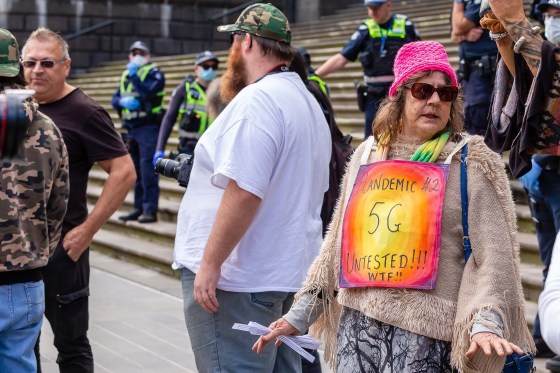
As in the United States, QAnon in Australia and New Zealand has mixed with other global conspiracy theories, including false beliefs that 5G towers are spreading coronavirus, unfounded claims that COVID-19 was either pre-planned or is a hoax and baseless theories about public vaccination programs. That turgid brew of misinformation is increasingly moving offline and spilling over into the streets in the form of protests or sometimes aggressive refusals to follow social distancing restrictions.
“We have seen the emergence of transnational, amorphous conspiracy-theory based movements,” says Joshua Roose, a senior research fellow at Deakin University in Australia. “All share a strong distrust in government and state institutions.”
QAnon began in 2017 as a uniquely American conspiracy theory. Followers of the movement, which has moved from far-right Internet forums onto mainstream social media sites, believe that President Donald Trump is fighting against a shadowy secret society that runs the world. Supporters claim this elite cabal is comprised of Democratic politicians, Satan-worshipping pedophiles and Hollywood celebrities who run a global child sex-trafficking ring, harvesting the blood of children for life-sustaining chemicals. None of this has any basis in fact.
The local strain of QAnon appears to be spurred by anger at COVID-19 restrictions: A resurgence of COVID in July forced the Australian state of Victoria—where Melbourne is located—into one of the most restrictive lockdowns in the world for weeks. In New Zealand, a small coronavirus outbreak in August also forced the government to reimpose restrictions in Auckland, the largest city.
Lockdown measures have eased in both countries, but supporters of QAnon continue to spread their conspiracy theories online—and, increasingly, offline. QAnon signs cropped up at “Freedom Day” anti-lockdown protests across Australia on Sept. 5, as well as at similar protests in Auckland.
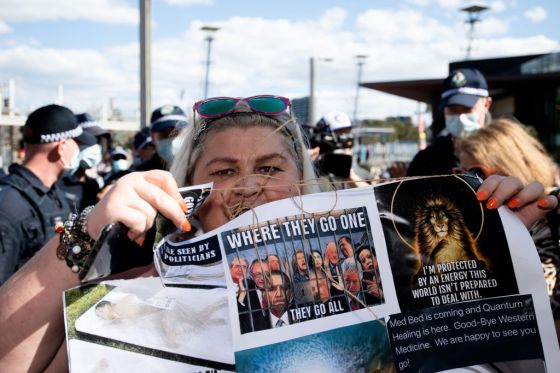
At checkpoints set up to ensure citizens are following COVID-19 movement restrictions in the state of Victoria in August, police were forced to smash several peoples’ car windows and drag them out for refusing to provide personal details because they claimed to be “sovereign citizens”.
The fringe movement started in the United States in the 1970s, with followers believing that ultimate power is vested in individuals, who are therefore not obligated to obey government rules they disagree with, whether that be motor vehicle regulations, answering to the police or paying taxes. Videos of the Victoria arrests have been widely shared on social media accounts that also spread QAnon theories—further fueling anger over COVID-19 restrictions.
Read more: The Misinformation Age Has Exacerbated—And Been Exacerbated By—the Coronavirus Pandemic
QAnon may center around an American conspiracy theory, but that hasn’t stopped supporters in Australia and New Zealand from adding their own local flavors.
One twist involves the hundred miles of storm drain tunnels running beneath Melbourne. Some Australian QAnon posts claim that Melbourne’s coronavirus lockdown was meant to keep the streets clear for an operation to rescue child sex-trafficking victims in the tunnels. (There is no evidence of this.)
The conspiracy theory also predicts the arrest of high-level officials for sex trafficking crimes. Again, resourceful Australian QAnon followers have adapted that narrative for their home turf. One Facebook post seen by TIME (falsely) alleged that Australia’s Prime Minister Scott Morrison has been under house arrest since January. The evidence? Blurry, close-up photos of Morrison wearing long pants, which appear to have either bunched up or been folded at the ankle and supposedly prove the Australian leader is wearing an ankle monitor.
Similar (false) rumors have also circulated using pictures that show Victoria Premier Dan Andrews walking down the street. Andrews, who has faced heavy criticism from the right for weeks-long coronavirus lockdowns this summer, features heavily in posts on QAnon-affiliated pages.
At a rally in New Zealand in early September, protesters referenced multiple COVID-19 conspiracy theories, according to local reports. But demonstrators have also woven in local causes. Some protesters were seen holding signs calling to “ban 1080,” a reference to the government’s use of poison to control populations of invasive rodents (the cause has been supported by some mainstream groups in recent years, but has been fodder for conspiracy theorists.) At least one protester was spotted with a sign that depicted Prime Minister Jacinda Ardern as Adolf Hitler.
One social media post in May claimed that Bill Gates was in New Zealand and asserted that the country of 5 million is a “perfect” nation “to test and trial” a vaccine for the coronavirus. (A spokesperson for the Bill & Melinda Gates Foundation said Gates had not been in New Zealand.)
And combining QAnon’s American roots with local feelings often meshes in inconsistent ways. For example, many Australian QAnon-affiliated accounts are highly critical of Australian police, who have used tough responses to enforce COVID-19 restrictions. Those posts are often shared alongside rightwing U.S. media articles praising American officers.
Read More: Here’s Why Experts Worry About the Popularity of QAnon’s Conspiracy Theory
Despite its presence at protests, QAnon really thrives online, and it gained a substantial foothold in Australia and New Zealand during COVID-19 lockdowns. One Facebook group started in Australia, comprising a mix of people denying the existence of the coronavirus, anti-vaxxers, so-called sovereign citizens and QAnon supporters, had more than 65,000 members before it was removed by the social media giant.
“You put marginalized people under pressure and fear and they look for non-mainstream and unorthodox theories to regain their sense of control and agency,” says Michael Grimshaw, of the University of Canterbury in New Zealand.
The conspiracy theories—and opposition to coronavirus restrictions in general—remain at the fringes in both nations. A recent Pew poll shows that 94% of Australians think the country did a good job handling the pandemic (the same poll reported that only 47% of Americans felt the same way). An August poll found that public confidence in health officials in New Zealand was above 80%.
But misinformation is increasingly bleeding over into the mainstream. Australian television chef Pete Evans—who has 275,000 Instagram followers—has posted QAnon-related content on Instagram in recent months. In New Zealand, a lifestyle influencer with more than 60,000 followers posted in support of QAnon claims in her Instagram story. “There’s soooooo much I want and need to address on here. But I’m going to start slowly and it will start with Hollywood, Cabal and Human Trafficking,” she said in one Instagram story. “People may think why? That’s America it has nothing to do with us. In the big scheme of things it has EVERYTHING to do with us. All you need to do is research Jacinda Ardern and her ties with Bill Gates…”
Both Facebook and Twitter say they’re taking action against QAnon-related content. Twitter announced in late July a stronger approach to dealing with QAnon, including permanently suspending accounts that violate its policies, banning URLs associated with QAnon from being shared on the site, limiting content from its trends and recommendations and not highlighting it in searches.
Facebook said in August it had removed 790 groups, 100 pages and 1,500 ads tied to QAnon and other groups it said support violence and blocked more than 300 hashtags across Facebook and Instagram worldwide. The company says that QAnon pages, groups and accounts will be removed when they violate Facebook’s community standards, including inciting violence. The company also said it will limit some content from recommendations and the ranking of this content will be lower in News Feed.
Despite their efforts to reduce the accessibility of QAnon content, a quick search shows Australia and New Zealand-specific QAnon conspiracy theories are widely available on both platforms. TIME found at least three separate Twitter accounts, with thousands of followers each, that used Australian QAnon hashtags in their profiles. TIME also found public Facebook groups specific to Australia and New Zealand that hosted QAnon posts, each with hundreds of members.
Three Facebook groups with QAnon-related posts that TIME asked the company about remain public. Facebook said that one post alleging the Australian Prime Minister is under house arrest would be removed when TIME inquired about it. But days later the post was still available on the platform. Facebook said this was due to a technical glitch on their end. However, at least one other post on the group also made the same false allegation about the Prime Minister.
One Australia-focused QAnon account with more than 4,000 followers was removed by Twitter for “multiple account violations” after TIME inquired about it.
Increasingly, ordinary Internet users are spreading QAnon-related memes and theories. Lydia Khalil, a research fellow at the Sydney-based think-tank the Lowy Institute, says some conspiracy theories have spread via mommy blogs, and fitness and wellness influencers, who have latched on to the child-sex trafficking and anti-vaccine elements of these theories.
“Not all of the people spreading this stuff are hard-core conspiracy theorists or extremists, they’re picking up on hashtags or more nebulous elements of this and then pushing it out without really understanding who’s behind it and where it’s coming from,” she says.
But leaders in Australia and New Zealand have been forced to publicly address some of the conspiracy theories because they became so prevalent. Australian officials have been forced to publicly refute the link between 5G and coronavirus, and on a television program on Aug. 5, Prime Minister Scott Morrison told people identifying as “sovereign citizens” and anti-maskers intentionally defying coronavirus restrictions to “get real.”
New Zealand’s health minister asked the public at a Sept. 10 COVID-19 briefing to “think twice before sharing information that can’t be verified.”
Matthew Schlapfer, a business consultant who lives in the Australian city of Perth, says he’s unfriended or been unfriended by about 10 people in recent months as he got fed up with seeing conspiracy theories filling his Facebook feed.
“I started getting really annoyed and reaching out and saying ‘where are you getting your information from?'” he says. “I would ask ‘what’s the source for this?'” and they couldn’t tell me.
Schalpfer, who is in his mid-forties, says many of the posts that started the disagreements were related to QAnon. Others argued against the use of vaccines, or falsely proclaimed that COVID is a hoax. Some of his former friends—including two ex-girlfriends, three former colleagues and several high school acquaintances—have posted messages supporting Trump.
“They have fully bought into this Trump saving us from the deep state and this global child pedophilia ring run by the liberal elites thing,” Schlapfer says.


YEREVAN, Armenia — Leaders of Azerbaijan and Armenia brushed off the suggestion of peace talks Tuesday, accusing each other of obstructing negotiations over the separatist territory of Nagorno-Karabakh, with dozens killed and injured in three days of heavy fighting.
In the latest incident, Armenia said one of its warplanes was shot down by a fighter jet from Azerbaijan’s ally Turkey, killing the pilot, in what would be a major escalation of the violence. Both Turkey and Azerbaijan denied it.
The international community is calling for talks to end the decades-old conflict between the two former Soviet republics in the Caucasus Mountains region following a flareup of violence this week. It centers on Nagorno-Karabakh, a region that lies within Azerbaijan but has been under the control of ethnic Armenian forces backed by the Armenian government since 1994 at the end of a separatist war.
The U.N. Security Council called on Armenia and Azerbaijan Tuesday evening to immediately halt the fighting and urgently resume talks without preconditions. The U.N.’s most powerful body strongly condemned the use of force and backed Secretary-General Antonio Guterres’ earlier call to stop the fighting, deescalate tensions, and resume talks “without delay.”
Azerbaijani President Ilkham Aliyev told Russian state TV channel Rossia 1 that Baku is committed to negotiating a resolution but that Armenia is obstructing the process.
“The Armenian prime minister publicly declares that Karabakh is (part of) Armenia, period. In this case, what kind of negotiating process can we talk about?” Aliev said. He added that according to principles brokered by the Minsk group, which was set up in 1992 by the Organization for Security and Cooperation in Europe to resolve the conflict, “territories around the former Nagorno-Karabakh autonomous region should be transferred to Azerbaijan.”
Aliev noted that if Armenian Prime Minister Nikol Pashinyan says “that Karabakh is Armenia and that we should negotiate with the so-called puppet regime of Nagorno-Karabakh, (he is) trying to break the format of negotiations that has existed for 20 years.”
Pashinyan, in turn, told the broadcaster that “it is very hard to talk about negotiations … when specific military operations are underway.” He said there is no military solution to the conflict and called for a compromise.
But first, Azerbaijan must “immediately end (its) aggression towards Nagorno-Karabakh and Armenia,” Pashinyan said. “We all perceive this as an existential threat to our nation, we basically perceive it as a war that was declared to the Armenian people, and our people are now simply forced to use the right for self-defense.”
Since Sunday, the Nagorno-Karabakh Defense Ministry reported 84 servicemen were killed. Aliyev said 11 civilians were killed on its side, although he didn’t detail the country’s military casualties.
Both countries accused each other of firing into their territory outside of the Nagorno-Karabakh area on Tuesday.
The separatist region of about 4,400 square kilometers (1,700 square miles), or about the size of the U.S. state of Delaware, is 50 kilometers (30 miles) from the Armenian border. Soldiers backed by Armenia also occupy some Azerbaijani territory outside the region.
Armenia also alleged that Turkey, which supports Azerbaijan, was involved. “Turkey, according to our information, looks for an excuse for a broader involvement in this conflict,” Pashinyan said.
The Armenian military said an SU-25 from its air force was shot down in Armenian airspace by a Turkish F-16 fighter jet that took off from Azerbaijan, and the pilot was killed.
The allegation of downing the jet was “absolutely untrue,” said Fahrettin Altun, communications director for Turkey’s president. Azerbaijani officials called it “another fantasy of the Armenian military propaganda machine.”
Turkish President Recep Tayyip Erdogan urged Armenia to withdraw immediately from the separatist region, and Turkish Foreign Minister Mevlut Cavusoglu said Turkey is “by Azerbaijan’s side on the field and at the (negotiating) table.”
Armenian officials said that Turkey, a NATO member, is supplying Azerbaijan with fighters from Syria and weapons, including F-16 fighter jets. Both Azerbaijan and Turkey deny it.
Earlier in the day, Azerbaijan’s Defense Ministry said Armenian forces shelled the Dashkesan region in Azerbaijan. Armenian officials said Azerbaijani forces opened fire on a military unit in the Armenian town of Vardenis, setting a bus on fire and killing one civilian.
Armenia’s Foreign Ministry denied shelling the region and said the reports were laying the groundwork for Azerbaijan “expanding the geography of hostilities, including the aggression against the Republic of Armenia.”
German Chancellor Angela Merkel has pushed for “an immediate cease-fire and a return to the negotiating table” in phone calls with the leaders of both countries, her office said.
She told them the OSCE offers an appropriate forum for talks and that the two countries’ neighbors “should contribute to the peaceful solution,” said her spokesman, Steffen Seibert.
U.S. Secretary of State Mike Pompeo said during a visit to Greece that “both sides must stop the violence” and work “to return to substantive negotiations as quickly as possible.”
Russia, which along with France and the United States co-chairs the Minsk group, urged every country to help facilitate a peaceful resolution of the conflict.
“We call on all countries, especially our partners such as Turkey, to do everything to convince the opposing parties to cease fire and return to peacefully resolving the conflict by politico-diplomatic means,” Kremlin spokesman Dmitry Peskov said Tuesday.
Putin spoke to Pashinyan on Tuesday for the second time in three days, urging de-escalation and, like the other leaders, an immediate cease-fire.
—-
Associated Press writers Daria Litvinova in Moscow, Geir Moulson in Berlin, Suzan Fraser in Ankara and Elena Becatoros in Athens contributed.


As President, Donald Trump has cast China as a global villain: a malevolent actor that all but launched a worldwide pandemic on an unsuspecting world, robbed Americans of their jobs and stole U.S. business secrets. He has made the Chinese Communist Party a catch-all enemy that pulls puppet-like strings to make international organizations like the World Health Organization work at cross-purposes with Washington, all charges Beijing vigorously denies.
At the same time, Trump has presented himself to the world—and to U.S. voters—as the only person capable of pummeling Beijing into submission, chiefly through a landmark trade deal. Democrats, the President and his allies say, are the willing patsies who bow to Beijing, as when former Vice President-turned-Democratic presidential candidate Joe Biden sought closer ties to the growing superpower in his multiple visits there. “A rising China is a positive, positive development, not only for China but for America and the world writ large,” Biden said in 2011 after returning to the U.S. from one such trip.
It’s a black-and-white narrative that will be argued on stage Tuesday night during the first Presidential debate in Cleveland, Ohio, with each man’s record and the COVID-19 pandemic on the debate docket. China will loom large for its role as Trump’s designated fall guy for the virus that has killed more than 200,000 Americans, for its economy, which is thriving despite the pandemic, and for its military, which could surpass America’s in size and strength by 2049.
Biden heads for the debate stage buoyed by an August Fox News poll that shows more Americans trust him over Trump to handle China. He is sure to point out Trump’s swings between painting China as an existential threat to the U.S. and effusive praise for Chinese leader Xi Jinping.
But many Trump supporters, if not most Americans, have become accustomed to Trump’s praise of strongmen in public, which in this case has given way to a barrage of insults, slamming Xi for letting the “Wuhan virus” spread. And Trump’s arguments that the Obama Administration was fooled by China could be persuasive on live television, says Michael Green, an Asia specialist from the Center for Strategic and International Studies. “The Trump Administration’s line,” says Green, a former Bush official who has backed Biden, “is that everybody was duped by China.” Green says that is “ridiculous and wrong…but it’s a pretty easy line to use in a debate.”
It will be tricky for Biden to counter these charges in clear terms to the American people. During his early years as Vice President, Washington and key allies like the U.K. were still hopeful of working with China, guardedly optimistic that Chinese Communist Party leaders could be carrot-pulled into more free-market, human-rights and democracy-oriented behavior.
The last year has seen China double down in a different direction. Its crackdown on Hong Kong demonstrators culminated in enacting a National Security Law on the region, decades ahead of the city’s agreed return to Chinese rule, and it has continued its crackdown on Muslim Uighurs, with hundreds of thousands reportedly sent to re-education camps.
The Trump Administration has accused Chinese leaders of being slow to tell the world how easily COVID-19 was spreading from person to person, and slow to admit a WHO team trying to investigate the outbreak. The Administration criticized China for releasing a DNA map of the virus without also sharing actual physical samples, which could help determine whether it jumped from animals or originated in a Chinese weapons lab, a popular but unsubstantiated theory among some in the GOP that is ridiculed by Chinese officials.
The Trump Administration has pursued a go-it-alone policy of using economic pain to bring Beijing to the negotiating table, aiming to check unfair trading practices and China’s aggressive militarization in the South China Sea. The Administration has slapped hundreds of billions of tariffs on Chinese goods, and imposed sanctions against alleged Chinese hackers accused of stealing U.S. intellectual property. The U.S. has also sanctioned Chinese officials who have cracked down on Hong Kong and the country’s Muslim Uighur minority.
The tough talk led to the January signing of the first phase of a trade deal, which keeps U.S. tariffs on Chinese goods largely intact, with the threat of more if China doesn’t follow through, and requires Beijing to buy upwards of $200 million in U.S. goods and services over the next two years. As of August, China has only bought $56.1 billion in U.S. goods, according to the Peterson Institute for International Economics, and with Trump skewering Beijing verbally at every opportunity, doesn’t appear to be working to step up spending.
Meanwhile, China’s global exports rose this summer, mainly because of its dominance of personal protective equipment manufacturing and work-from-home technology, according to the Council on Foreign Relations, while the U.S. trade deficit with China has grown. The U.S.-China trade war had already cost 300,000 jobs since it started in early 2018, according to Moody Analytics, even before the coronavirus wreaked havoc on the U.S. job market.
Biden’s own approach to China, as outlined in his public comments so far, sounds like a Trump-lite trade policy with a side of wishful thinking that Beijing can still be coaxed back to better behavior by a concerted scolding by Washington and its allies. He told the Council on Foreign Relations he would double down on Trump’s sanctions over the Hong Kong security law and its detention of up to a million minority Uighurs, but he told NPR that he would lift tariffs on Chinese imports and work through international trade bodies like the WTO to bring Beijing to heel.
Biden claims a key tool to counter China would be to super-charge those measures in cooperation with allies, in part by renegotiating the Trump-abandoned Trans-Pacific Partnership (TPP) trade deal, an acronym that by itself can cause eyes to glaze, to band Pacific economies against Beijing. As Biden wrote in Foreign Affairs, “The most effective way to meet that challenge is to build a united front of U.S. allies and partners to confront China’s abusive behaviors and human rights violations, even as we seek to cooperate with Beijing on issues where our interests converge.”
Explaining that on stage on Tuesday would be a wonky turn likely lost on any popular audience, who may not remember that it was combined allied economic action against Iran that brought it to the negotiating table for the Iran nuclear deal, an argument that would draw scorn from most Republicans.
Trump, for his part, will likely argue that if a tougher tack had been taken sooner, it might have clipped Beijing’s wings—though some current and former U.S. military and intelligence officers will tell you China was always heading this way, citing hawkish books like The Hundred-Year Marathon, which relies on Chinese documents and defectors to claim, controversially, that China intends to replace the U.S. as a global superpower by 2049.
Trump has already previewed a debate attack to come on Biden’s son Hunter, who Trump has claimed made more than a billion dollars in an investment deal with the Bank of China, less than two weeks after flying there on his father’s plane in 2013, a charge that multiple fact-checks have found false. Hunter Biden’s spokesperson George Mesires tells TIME that he has “never made any money” from BHR Partners, the company he founded that struck the deal, “either from his former role as a director, or on account of his equity investment, which he is actively seeking to divest.”
When Biden served as Vice President, he helped launch Obama’s 2009 “U.S.-China Strategic and Economic Dialogue.” At the time, it seemed that Washington and Beijing could work together toward common good in the service of mutual interests. Those early efforts arguably produced tangible results, as when both countries signed up to the Paris Climate Agreement in 2016, together representing 40% of the world’s greenhouse gas emissions. “We are moving the world significantly towards the goal we have set,” Obama said of the nations’ cooperation. China also “tightened its controls on weapons sold to Iran” in response to U.S. pressure, according to a Brookings Institution review, and the countries worked together to keep North Korea in check.
“There was very broad bipartisan support for a strategy towards China… that mixed engagement with China, and counterbalancing China by keeping our defenses strong, pushing on human rights, and especially working with allies, like Japan, and Australia,” says Green, the former Bush NSC official.
The mood soured, however, by the second Obama/Biden term, with the Obama Administration decrying thousands of cyberattacks a day on the U.S. government by Chinese military hackers, and later arresting a Chinese national for the theft of millions of government employees’ personal records from the Office of Personnel Management by a secretive Chinese military hacking unit, leading to a bilateral anti-hacking pact that the Trump Administration later accused the Chinese of violating.
Obama and Biden also negotiated the TPP—which Trump swiftly pulled out of after his inauguration in 2017—to gather together 12 regional Pacific economies, representing 40% of the world’s trade, into a single trading market to offset China’s economic bullying. And Obama’s military challenged China’s construction of an artificial island and military base in the South China Sea with its own “presence patrols” of U.S. Naval vessels steaming through sea channels in international waters that China was trying to claim for its own.
All of the Obama Administration’s efforts were eventually swallowed up and erased, like the wakes of those U.S. Naval ships, in part by Trump’s TPP departure, but mostly by the steady waves of a strategically planned and clinically executed Chinese campaign to widen its economic influence, build its military might, and become a diplomatic superpower that cannot be ignored on any major international issue.
The U.S. public hasn’t paid much heed to China’s long-game, but the COVID-19 crisis has caused more Americans to see China negatively, according to a Pew Research Service poll released in July. It’s against that backdrop that Biden will have to explain to information-overwhelmed American viewers why he once entertained the notion that China’s Communist Party could be reasoned with, and how his policies would produce a different result than the steadily increasing cold war between Beijing and Washington.
China-focused political economist Derek Scissors, of the right-leaning American Enterprise Institute, believes both candidates are weak on China. He says the first phase of the President’s trade deal is a “failure,” with U.S. exports to China “far behind schedule,” U.S. portfolio investment in China soaring, Beijing’s hack-and-grab theft of U.S. intellectual property continuing, and Trump’s sanctions having little effect on Chinese tech companies’ predatory behavior.
On the other hand, Biden’s China record is one of “wishful thinking,” Scissors says, mostly focused on global climate change initiatives. “The Obama Administration was paralyzed by hope for meaningful Chinese cooperation, instead getting an increasingly nasty dictatorship,” he says. “Biden’s move away from that approach is unconvincing so far.”
Retired Amb. Joseph DeTrani, former CIA director of East Asia Operations, says both candidates behaved appropriately for the China they faced at the time. In Biden’s engagement with China as a Senator during the 1980s and 1990s “bilateral relations were solid,” he says, so cooperative moves like championing Beijing’s entry into the World Trade Organization were appropriate. When tensions later rose, the Obama Administration announced its “pivot” to East Asia, concerned about China’s behavior in the South and East China Seas and its ambitious Belt and Road Initiative, which ostensibly aimed to improve China’s physical access to markets by building roads, bridges and ports globally, but instead often trapped countries in debt-ridden deals that forced them to forfeit ownership of the projects to the Chinese.
DeTrani says Trump can argue that he, rather than his predecessors, acted against Beijing’s predatory trade practices, including “a very unfavorable historical trade imbalance with China, something previous administrations ignored.” He points out that Trump’s position hardened when it became clear China hadn’t shared data on the pandemic “in a timely way,” and with its crackdown on Hong Kong, the proliferation of Uighur reeducation camps and other human rights abuses.
With China’s military growing, already outpacing the U.S. Navy, and its still-expanding economy keeping it on track to eclipse U.S. power in the next decade, according to the Australia-based Lowy Institute, the next U.S. president will be facing a formidable adversary that no recent American leader has managed to check.


With an ever-climbing tally of COVID-19 infections, deaths, and calculations about how quickly the virus is spreading, the numbers can start to lose meaning. But one million is a resonant milestone.
According to the Johns Hopkins Coronavirus Resource Center, the world has now lost one million lives to the new coronavirus. It’s easy to draw analogies—one million people dying of COVID-19 would be the equivalent of just over the entire population of a country like Djibouti, or just under the populace of Cyprus. Perhaps more sobering would be to think of that number less as an entity and more in terms of the precious individual lives it represents. It’s a chance to remind ourselves that each of those deaths is a mother, a father, a grandmother, a grandfather, a friend, a loved one.
It’s also a warning to learn from these deaths so they haven’t occurred in vain. When the novel coronavirus burst into the world last winter, the best virus and public health experts were initially helpless to combat infections in a world where almost nobody had any immunity to fight it. As a result, the mortality rate, which hovered just under 3% around the world starting in late January, slowly began to creep upward, doubling in two months and hitting a peak of more than 7% at the end of April before inching downward again.
While every death from COVID-19 is one too many, public health experts see some hope in the fact that while new cases continue to pile up around the world, deaths are starting to slow. That declining case fatality curve was and continues to be fueled by everything we have learned about SARS-CoV-2 (the COVID-19 virus) and everything that we have put into practice to fight it. That includes using experimental therapies like the antiviral drug remdesivir, as well as existing anti-inflammatory medicines that reduce the inflammation that can compromise and damage the lungs and respiratory tissues in the most severely ill patients.
That falling case fatality is also due in part to wider adoption of prevention strategies such as frequent hand washing, mask wearing and social distancing. And to the fact that globally, we began testing more people so those who are infected can then self-isolate quickly.
Read more: The Lives Lost to Coronavirus
Still, another thing we have learned from the pandemic is that deaths often lag behind cases, sometimes by months. And the number of cases globally continues to increase, especially in new hot spots in South America and India, so the declining curve of the fatality rate hasn’t necessarily led to fewer overall deaths.
Understanding how the geography and nature of COVID-19 deaths have shifted in recent months will be critical to maintaining any progress we’ve made, as nations and as a species, in suppressing COVID-19. In the U.S., for example, deaths early in the pandemic were centered in densely populated metropolitan areas, where infections spread quickly and hospitals became overwhelmed with severely ill people needing intensive care and ventilators to breathe. The virus had the advantage, and exploited the fact that there wasn’t much that science or medicine could do to fight it.
The only strategy was to take ourselves out of the virus’s way. Lockdowns that prohibited gatherings, mandates for social distancing and requirements that people wear masks in public helped to slow transmission and gradually reduce mortality, as the most vulnerable were protected from infection. But nine months into the pandemic, deaths are beginning to rise in less populated parts of the country. Medium- and small-sized cities and rural areas accounted for around 30% of U.S. deaths at their peak in late April, but in September they have been responsible for about half of COVID-19 deaths in the country.
The reason for that, public health experts suspect, has to do with the false sense of security that less populated communities felt and the assumption that the virus wouldn’t find them. Less stringent requirements and enforcement of social distancing and basic hygiene practices like hand washing and mask-wearing could have provided SARS-CoV-2 the entrée it needed to find new chances to infect people as those opportunities in more populated regions began to dwindle. Furthermore, health resources in rural areas aren’t as well distributed as they are in metropolitan regions, which makes preparing for an infectious disease more challenging.
Globally, COVID-19 mortality also reflects the unequal distribution of health care around the world. While developed countries are able to rely on existing resources—including hospital systems equipped with the latest medical tools and well-trained nurses and doctors—those resources aren’t as robust in lower income countries where health care isn’t always a high national priority. That puts these countries at greater risk of higher fatality from COVID-19 as new infections climb. Without medical equipment and personnel to ramp up testing and isolate infected people, or to care for the sickest patients, deaths quickly follow new infections.
That tragic reality is being borne out in recent case fatality trends. While the U.S. continues to lead the world in overall COVID-19 cases and deaths, the burden of deaths is shifting to countries such as Brazil and Mexico; Brazil has just over half the number of deaths of the U.S. Deaths in India are also likely to continue inching upward before they start to decline, as survival there under lockdown conditions is nearly impossible for families that have no income to buy food and pay rent. The pressure to reopen and re-emerge into densely populated cities will provide more fertile ground for COVID-19 to spread—and to claim more lives—before better treatments and vaccines can start to suppress the virus’ relentless blaze of despair.

With an ever-climbing tally of COVID-19 infections, deaths, and calculations about how quickly the virus is spreading, the numbers can start to lose meaning. But one million is a resonant milestone.
According to the Johns Hopkins Coronavirus Resource Center, the world has now lost one million lives to the new coronavirus. It’s easy to draw analogies—one million people dying of COVID-19 would be the equivalent of just over the entire population of a country like Djibouti, or just under the populace of Cyprus. Perhaps more sobering would be to think of that number less as an entity and more in terms of the precious individual lives it represents. It’s a chance to remind ourselves that each of those deaths is a mother, a father, a grandmother, a grandfather, a friend, a loved one.
It’s also a warning to learn from these deaths so they haven’t occurred in vain. When the novel coronavirus burst into the world last winter, the best virus and public health experts were initially helpless to combat infections in a world where almost nobody had any immunity to fight it. As a result, the mortality rate, which hovered just under 3% around the world starting in late January, slowly began to creep upward, doubling in two months and hitting a peak of more than 7% at the end of April before inching downward again.
While every death from COVID-19 is one too many, public health experts see some hope in the fact that while new cases continue to pile up around the world, deaths are starting to slow. That declining case fatality curve was and continues to be fueled by everything we have learned about SARS-CoV-2 (the COVID-19 virus) and everything that we have put into practice to fight it. That includes using experimental therapies like the antiviral drug remdesivir, as well as existing anti-inflammatory medicines that reduce the inflammation that can compromise and damage the lungs and respiratory tissues in the most severely ill patients.
That falling case fatality is also due in part to wider adoption of prevention strategies such as frequent hand washing, mask wearing and social distancing. And to the fact that globally, we began testing more people so those who are infected can then self-isolate quickly.
Read more: The Lives Lost to Coronavirus
Still, another thing we have learned from the pandemic is that deaths often lag behind cases, sometimes by months. And the number of cases globally continues to increase, especially in new hot spots in South America and India, so the declining curve of the fatality rate hasn’t necessarily led to fewer overall deaths.
Understanding how the geography and nature of COVID-19 deaths have shifted in recent months will be critical to maintaining any progress we’ve made, as nations and as a species, in suppressing COVID-19. In the U.S., for example, deaths early in the pandemic were centered in densely populated metropolitan areas, where infections spread quickly and hospitals became overwhelmed with severely ill people needing intensive care and ventilators to breathe. The virus had the advantage, and exploited the fact that there wasn’t much that science or medicine could do to fight it.
The only strategy was to take ourselves out of the virus’s way. Lockdowns that prohibited gatherings, mandates for social distancing and requirements that people wear masks in public helped to slow transmission and gradually reduce mortality, as the most vulnerable were protected from infection. But nine months into the pandemic, deaths are beginning to rise in less populated parts of the country. Medium- and small-sized cities and rural areas accounted for around 30% of U.S. deaths at their peak in late April, but in September they have been responsible for about half of COVID-19 deaths in the country.
The reason for that, public health experts suspect, has to do with the false sense of security that less populated communities felt and the assumption that the virus wouldn’t find them. Less stringent requirements and enforcement of social distancing and basic hygiene practices like hand washing and mask-wearing could have provided SARS-CoV-2 the entrée it needed to find new chances to infect people as those opportunities in more populated regions began to dwindle. Furthermore, health resources in rural areas aren’t as well distributed as they are in metropolitan regions, which makes preparing for an infectious disease more challenging.
Globally, COVID-19 mortality also reflects the unequal distribution of health care around the world. While developed countries are able to rely on existing resources—including hospital systems equipped with the latest medical tools and well-trained nurses and doctors—those resources aren’t as robust in lower income countries where health care isn’t always a high national priority. That puts these countries at greater risk of higher fatality from COVID-19 as new infections climb. Without medical equipment and personnel to ramp up testing and isolate infected people, or to care for the sickest patients, deaths quickly follow new infections.
That tragic reality is being borne out in recent case fatality trends. While the U.S. continues to lead the world in overall COVID-19 cases and deaths, the burden of deaths is shifting to countries such as Brazil and Mexico; Brazil has just over half the number of deaths of the U.S. Deaths in India are also likely to continue inching upward before they start to decline, as survival there under lockdown conditions is nearly impossible for families that have no income to buy food and pay rent. The pressure to reopen and re-emerge into densely populated cities will provide more fertile ground for COVID-19 to spread—and to claim more lives—before better treatments and vaccines can start to suppress the virus’ relentless blaze of despair.


President Donald Trump paid just $750 in federal income taxes the year he ran for president and in his first year in the White House, according to a report Sunday in The New York Times.
Trump, who has fiercely guarded his tax filings and is the only president in modern times not to make them public, paid no federal income taxes in 10 of the past 15 years.
The details of the tax filings complicate Trump’s description of himself as a shrewd and patriotic businessman, revealing instead a series of financial losses and income from abroad that could come into conflict with his responsibilities as president. The president’s financial disclosures indicated he earned at least $434.9 million in 2018, but the tax filings reported a $47.4 million loss.
The tax filings also illustrate how a reputed billionaire could pay little to nothing in taxes, while someone in the middle class could pay substantially more than him. Nearly half of Americans pay no income taxes, primarily because of how their low incomes are. But IRS figures indicate that the average tax filer paid roughly $12,200 in 2017, about 16 times more than what the president paid.
The disclosure, which the Times said comes from tax return data it obtained extending over two decades, comes at a pivotal moment ahead of the first presidential debate Tuesday and weeks before a divisive election against Democrat Joe Biden.
Speaking at a news conference Sunday at the White House, Trump dismissed the report as “fake news” and maintained he has paid taxes, though he gave no specifics. He also vowed that information about his taxes “will all be revealed,” but he offered no timeline for the disclosure and made similar promises during the 2016 campaign on which he never followed through.
In fact, the president has fielded court challenges against those seeking access to his returns, including the U.S. House, which is suing for access to Trump’s tax returns as part of congressional oversight.
During his first two years as president, Trump received $73 million from foreign operations, which in addition to his golf properties in Scotland and Ireland included $3 million from the Philippines, $2.3 million from India and $1 million from Turkey, among other nations. The president in 2017 paid $145,400 in taxes in India and $156,824 in the Philippines, compared to just $750 in U.S. income taxes. The Times said the tax records did not reveal any unreported connections to Russia.
Trump found multiple ways to reduce his tax bills. He has taken tax deductions on personal expenses such as housing, aircraft and $70,000 to style his hair while he filmed “The Apprentice.” Losses in the property businesses solely owned and managed by Trump appear to have offset income from his stake in “The Apprentice” and other entities with multiple owners.
During the first two years of his presidency, Trump relied on business tax credits to reduce his tax obligations. The Times said $9.7 million worth of business investment credits that were submitted after Trump requested an extension to file his taxes allowed him to reduce his income and pay just $750 each in 2016 and 2017.
Income tax payments help finance the military and domestic programs.
Trump, starting in 2010, claimed and received an income tax refund that totaled $72.9 million, which the Times said was at the core of an ongoing audit by the IRS. The Times said a ruling against Trump could cost him $100 million or more. He also has more than $300 million in loans due to be repaid in the next four years.
Richard Neal, D-Mass., the chair of the House Ways and Means Committee who has tried unsuccessfully to obtain Trump’s tax records, said the Times report makes it even more essential for his committee to get the documents.
“It appears that the President has gamed the tax code to his advantage and used legal fights to delay or avoid paying what he owes,” Neal wrote in a statement. “Now, Donald Trump is the boss of the agency he considers an adversary. It is essential that the IRS’s presidential audit program remain free of interference.”
A lawyer for the Trump Organization, Alan Garten, and a spokesperson for the Trump Organization did not immediately respond to a request for comment from The Associated Press on the report.
Garten told the Times that “most, if not all, of the facts appear to be inaccurate.”
He said in a statement to the news organization that the president “has paid tens of millions of dollars in personal taxes to the federal government, including paying millions in personal taxes since announcing his candidacy in 2015.”
The New York Times said it declined to provide Garten with the tax filings in order to protect its sources, but it said its sources had legal access to the records.
During his first general election debate against Democrat Hillary Clinton in 2016, Clinton said that perhaps Trump wasn’t releasing his tax returns because he had paid nothing in federal taxes.
Trump interrupted her to say, “That makes me smart.”

(YEREVAN, Armenia) — Fighting erupted anew Sunday between Armenia and Azerbaijan over the disputed separatist region of Nagorno-Karabakh. Armenia said a woman and a child were killed in the area by shelling from Azerbaijani forces and Azerbaijan’s president said his military has suffered losses.
Armenia also claimed that two Azerbaijani helicopters were shot down and three Azerbaijani tanks were hit by artillery, but Azerbaijan’s defense ministry rejected that claim.
Heavy fighting broke out in the morning in the region that lies within Azerbaijan but has been under the control of ethnic Armenian forces backed by Armenia since 1994 at the end of a separatist war. It was not immediately clear what sparked the fighting, the heaviest since clashes in July killed 16 people from both sides.
Nagorno-Karabakh authorities reported that shelling hit the region’s capital of Stepanakert and the towns of Martakert and Martuni. Armenian Defense Ministry spokesman Artsrun Hovhannisyan also said Azerbaijani shelling hit within Armenian territory near the town of Vardenis.
Armenian human rights ombudsman Arman Tatoyan said a woman and a child were killed and two civilians wounded in the Martuni region.
Another Armenian Defense Ministry spokesperson, Shushan Stepanyan, said “the Armenian side” shot down two helicopters and hit three tanks.
Azerbaijan’s President Ilham Aliyev said in a televised address to the nation that “there are losses among the Azerbaijani forces and the civilian population as a result of the Armenian bombardment” but did not give further details.
He also claimed that “many units of the enemy’s military equipment have been destroyed.”
Russian Foreign Minister Sergey Lavrov Lavrov “is conducting intensive contacts in order to induce the parties to cease fire and start negotiations to stabilize the situation,” ministry spokeswoman Maria Zakharova said.
The news was harshly received in Turkey, a close ally of Azerbaijan.
Turkey’s ruling party spokesman Omer Celik tweeted: “We vehemently condemn Armenia’s attack on Azerbaijan. Armenia has once against committed a provocation, ignoring law.” He promised Turkey would stand by Azerbaijan and said, “Armenia is playing with fire and endangering regional peace.”
Turkish presidential spokesman Ibrahim Kalin also took to Twitter to condemn Armenia. “Armenia has violated the ceasefire by attacking civilian settlements … the international community must immediately say stop to this dangerous provocation.”
Mostly mountainous Nagorno-Karabakh — a region some 4,400 square kilometers (1,700 square miles) or about the size of the U.S. state of Delaware — lies 50 kilometers (30 miles) from the Armenian border. Local soldiers backed by Armenia also occupy some Azerbaijani territory outside the region.
At the Vatican, Pope Francis said Sunday thathe was praying for peace between the two countries, urging them to them to “accomplish concrete deeds of goodwill and fraternity” to reach a peaceful solution through dialogue.
—-
Jim Heintz in Moscow, Zeynep Bilginsoy in Istanbul and Giada Zampano in Rome contributed to this story.
