Police confirm at least two people have died and say they have arrested a man in his mid 20s.
from BBC News - World https://bbc.in/3mD0xqr

Saturday, October 31, 2020
El papa Francisco, la homosexualidad y la hipocresía de la Iglesia

By Guillermo Osorno from NYT en Español https://nyti.ms/3jG1RH6
Their First Try Backfired, but Giuliani and Allies Keep Aiming at Biden

By Kenneth P. Vogel, Jim Rutenberg and Maggie Haberman from NYT U.S. https://nyti.ms/3kLJiCB
Americans Surge to Polls: ‘I’m Going to Vote Like My Life Depends on It’

By Nick Corasaniti and Stephanie Saul from NYT U.S. https://nyti.ms/2HP7INc
Vehicles flying Trump flags try to force a Biden-Harris campaign bus off a highway in Texas.
By David R. Montgomery and Maggie Haberman from NYT U.S. https://nyti.ms/3jMLB72
How Are Americans Catching the Virus? Increasingly, ‘They Have No Idea’

By Sarah Mervosh and Lucy Tompkins from NYT U.S. https://nyti.ms/3eeiV5W
Republicans, Not Biden, Are About to Raise Your Taxes

By Joseph E. Stiglitz from NYT Opinion https://nyti.ms/385CLzr
James Bond Actors Say Sean Connery ‘Defined an Era and a Style’

By Christina Morales from NYT Movies https://nyti.ms/3eceqca
After Trump accuses doctors of profiteering, medical professionals push back.

By Jacey Fortin from NYT U.S. https://nyti.ms/31XjjRm
Kendrick Lamar’s Welcome Return, and 11 More New Songs

By Jon Pareles, Giovanni Russonello and Lindsay Zoladz from NYT Arts https://nyti.ms/2TJwUYa
Nagorno-Karabakh conflict: Human cost of two nations fighting for 'Motherland'
The stories of families who have lost sons in the latest territorial war over Nagorno-Karabakh.
from BBC News - World https://bbc.in/2HUHNmZ
from BBC News - World https://bbc.in/2HUHNmZ
How the controversial Nile dam might fix Sudan's floods
Egypt and Ethiopia are at loggerheads over the mega dam, with Sudan literally stuck in the middle.
from BBC News - World https://bbc.in/34IBT1k
from BBC News - World https://bbc.in/34IBT1k
India couple bullied for intimate wedding photoshoot
Indian couple trolled for intimate post-wedding photoshoot refuses to give in to bullies.
from BBC News - World https://bbc.in/2HRFhyo
from BBC News - World https://bbc.in/2HRFhyo
'My parents had hearts of gold, they didn't deserve it'
How people are dealing with the effects of coronavirus in one New York neighbourhood.
from BBC News - World https://bbc.in/3kN4Lv9
from BBC News - World https://bbc.in/3kN4Lv9
The Miraculous Love Kids: Street kids changing their lives with guitars
The Beach Boys' Brian Wilson is just one star who's recorded with a group of girls from Afghanistan.
from BBC News - World https://bbc.in/3mFL09b
from BBC News - World https://bbc.in/3mFL09b
Belarus protests: The turtle 'anthem' protesters sing in Belarus
How music has featured prominently in the protests calling for President Lukashenko to step down.
from BBC News - World https://bbc.in/2HSjM09
from BBC News - World https://bbc.in/2HSjM09
Christians Worldwide Mark International Day of Prayer for the Persecuted Church
Millions of Christians worldwide will unite on Sunday, Nov. 1 to join the global Body of Christ for the 2020 International Day of Prayer for the Persecuted (IDOP).
from CBNNews.com https://bit.ly/3ecn22x Worldwide Mark International Day of Prayer for the Persecuted Church
from CBNNews.com https://bit.ly/3ecn22x Worldwide Mark International Day of Prayer for the Persecuted Church
Christians Worldwide Mark International Day of Prayer for the Persecuted Church
Millions of Christians worldwide will unite on Sunday, Nov. 1 to join the global Body of Christ for the 2020 International Day of Prayer for the Persecuted (IDOP).
from CBNNews.com https://bit.ly/2HRYfVD
from CBNNews.com https://bit.ly/2HRYfVD
US Election 2020: Biden and Trump in last weekend dash round swing states
Joe Biden is in Michigan while Donald Trump arrives in Pennsylvania, both key to the White House race.
from BBC News - World https://bbc.in/2TIaNkE
from BBC News - World https://bbc.in/2TIaNkE
US election: The big issue that could hurt Trump
Just ahead of the election, the US is seeing what could be the largest outbreak of the pandemic so far.
from BBC News - World https://bbc.in/2JqSNJN
from BBC News - World https://bbc.in/2JqSNJN
US election 2020: 'It just makes me feel like a nobody'
Former prisoner Davion Hampton from Florida wants to vote in this US election. But he can't.
from BBC News - World https://bbc.in/3mKu6GF
from BBC News - World https://bbc.in/3mKu6GF
US election: 'All Republicans should marry Democrats'
Chenren and Cathy Shao haven't let political differences get in the way of their eight-year marriage.
from BBC News - World https://bbc.in/3jKA9sI
from BBC News - World https://bbc.in/3jKA9sI
US election 2020: The great dividing line of this campaign
For some Americans, civil unrest after police shootings is driving their support for Donald Trump.
from BBC News - World https://bbc.in/37XhAzd
from BBC News - World https://bbc.in/37XhAzd
Friday, October 30, 2020
In Trump and Biden, a Choice of Teetotalers for President

By Adam Nagourney from NYT U.S. https://nyti.ms/35Ppp7x
In Michigan, a Suburban County That Flipped Blue Isn’t Looking Back

By Kathleen Gray from NYT U.S. https://nyti.ms/2THjvQk

Travis Roy, Who Inspired Millions After a Hockey Tragedy, Dies at 45

By Azi Paybarah from NYT Sports https://nyti.ms/3eaPJgd

Michael Skakel, Kennedy Cousin, Will Not Face 2nd Murder Trial

By Daniel E. Slotnik and Kristin Hussey from NYT New York https://nyti.ms/35Pou6X

40 Dead, Now 40 Laid Off: Inside a Nursing Home in Crisis

By John Leland and Christopher Occhicone from NYT New York https://nyti.ms/2HUuGlK
Late Night Is Too Nervous to Believe in Biden-Leading Polls

By Trish Bendix from NYT Arts https://nyti.ms/3myGCss
How social media is preparing for US election chaos
Social media companies are making plans in case of unrest after election day.
from BBC News - World https://bbc.in/35QfQoP
from BBC News - World https://bbc.in/35QfQoP
Far from home, Rohingya refugees face a new peril on a remote island
Bangladesh has begun relocating hundreds of refugees to a small remote island, against their will.
from BBC News - World https://bbc.in/3kNlRcb
from BBC News - World https://bbc.in/3kNlRcb
US election 2020: The Asians who are rooting for Trump to win
Some people in Asia see Donald Trump as their man to stand up to China - and nervously hope he'll be re-elected.
from BBC News - World https://bbc.in/3efYWUC
from BBC News - World https://bbc.in/3efYWUC
The Kashmir journalists 'harassed' and 'questioned' for doing their job
The BBC speaks to journalists in the region who say doing their job has become increasingly difficult.
from BBC News - World https://bbc.in/2HTascH
from BBC News - World https://bbc.in/2HTascH
The 400,000 seafarers who can't go home
Unions say Covid has in effect trapped thousands of seafarers on ships - waiting to go home.
from BBC News - World https://bbc.in/35MXBRj
from BBC News - World https://bbc.in/35MXBRj
Climate change: You've got cheap data, how about cheap power too?
The iPhone transformed mobile phones in just 10 years. Could green energy see a similar revolution?
from BBC News - World https://bbc.in/34GZOhB
from BBC News - World https://bbc.in/34GZOhB
US election 2020: Trump is in the fight of his political life
In the throes of an epoch-defining election, those looking for a healing process will be disappointed.
from BBC News - World https://bbc.in/37UYp9d
from BBC News - World https://bbc.in/37UYp9d
US election 2020: Fact-checking Trump and Biden's final week
The presidential campaigns are coming to an end. We've fact-checked the candidates' latest claims.
from BBC News - World https://bbc.in/3eaFQz0
from BBC News - World https://bbc.in/3eaFQz0
Coronavirus: Slovakia holds national test but president calls for delay
Everyone in Slovakia over the age of 10 is to be tested for Covid - but the president is sceptical.
from BBC News - World https://bbc.in/3mI0g5l
from BBC News - World https://bbc.in/3mI0g5l
Covid: Belgium announces return to national lockdown
Non-essential shops will close until mid-December to help curb the highest infection rate in Europe.
from BBC News - World https://bbc.in/3mEYAtv
from BBC News - World https://bbc.in/3mEYAtv
Fox News Breaking News Alert
Fox News Breaking News Alert
OFFICERS AMBUSHED: Two New Orleans cops shot at in French Quarter
10/30/20 5:30 PM
OFFICERS AMBUSHED: Two New Orleans cops shot at in French Quarter
10/30/20 5:30 PM
US election: What Latino first-time voters want
Every 30 seconds, a Latino in the US turns 18 and becomes eligible to vote.
from BBC News - World https://bbc.in/2HMCB4T
from BBC News - World https://bbc.in/2HMCB4T
Berlin airport opens... 10 years late
Berlin's new airport is finally opening to the public, 10 years behind schedule and billions over budget.
from BBC News - World https://bbc.in/31Uw8vK
from BBC News - World https://bbc.in/31Uw8vK
Scared but socially distant in a Tokyo 'haunted house'
Could this zombie-inspired experience be for people who want to be frightened but be Covid-19 safe?
from BBC News - World https://bbc.in/34GQCtB
from BBC News - World https://bbc.in/34GQCtB
Thursday, October 29, 2020
U.S. Coronavirus Cases Surpass 9 Million With No End in Sight

By Mitch Smith, Simon Romero and Giulia McDonnell Nieto del Rio from NYT U.S. https://nyti.ms/37V7Bub
How Will I Ever Look at America the Same Way Again?

By Frank Bruni from NYT Opinion https://nyti.ms/3kKfTZM
New York Nightmare: Man Falls Through Sidewalk Into Rat-Filled Chasm

By Mihir Zaveri from NYT New York https://nyti.ms/34CklnE
Death Rates Have Dropped for Seriously Ill Covid Patients

By Roni Caryn Rabin from NYT Health https://nyti.ms/3oGN8iY
The Wine World’s Most Elite Circle Has a Sexual Harassment Problem

By Julia Moskin from NYT Food https://nyti.ms/2HRo6fO
Jimmy Fallon: ‘Even Trump Supporters Are Turning Blue’

By Trish Bendix from NYT Arts https://nyti.ms/35KjrVv
In Azerbaijan, a String of Explosions, Screams and Then Blood

By Carlotta Gall from NYT World https://nyti.ms/2HPthwN
Cecilia Chiang, Who Brought Authentic Chinese Food to America, Dies at 100

By William Grimes from NYT Food https://nyti.ms/3kGIizN
New world news from Time: New Zealand Votes To Legalize Euthanasia but Not Marijuana
WELLINGTON, New Zealand — New Zealanders voted to legalize euthanasia in a binding referendum, but preliminary results released Friday showed they likely would not legalize marijuana.
With about 83% of votes counted, New Zealanders emphatically endorsed the euthanasia measure with 65% voting in favor and 34% voting against.
The “No” vote on marijuana was much closer, with 53% voting against legalizing the drug for recreational use and 46% voting in favor. That left open a slight chance the measure could still pass once all special votes were counted next week, although it would require a huge swing.
In past elections, special votes — which include those cast by overseas voters — have tended to be more liberal than general votes, giving proponents of marijuana legalization some hope the measure could still pass.
Proponents of marijuana legalization were frustrated that popular Prime Minister Jacinda Ardern wouldn’t reveal how she intended to vote ahead the Oct. 17 ballot, saying she wanted to leave the decision to New Zealanders. Ardern said Friday after the results were released that she had voted in favor of both referendums.
Conservative lawmaker Nick Smith, from the opposition National Party, welcomed the preliminary marijuana result.
“This is a victory for common sense. Research shows cannabis causes mental health problems, reduced motivation and educational achievement, and increased road and workplace deaths,” he said. “New Zealanders have rightly concluded that legalizing recreational cannabis would normalize it, make it more available, increase its use and cause more harm.”
But liberal lawmaker Chlöe Swarbrick, from the Green Party, said they had long assumed the vote would be close and they needed to wait until the specials were counted.
“We have said from the outset that this would always come down to voter turnout. We’ve had record numbers of special votes, so I remain optimistic,” she said. “New Zealand has had a really mature and ever-evolving conversation about drug laws in this country and we’ve come really far in the last three years.”
The euthanasia measure, which would also allow assisted suicide and takes effect in November 2021, would apply to adults who have terminal illnesses, are likely to die within six months, and are enduring “unbearable” suffering. Other countries that allow some form of euthanasia include The Netherlands, Luxembourg, Canada, Belgium and Colombia.
The marijuana measure would allow people to buy up to 14 grams (0.5 ounce) a day and grow two plants. It was a non-binding vote, so if voters approved it, legislation would have to be passed to implement it. Ardern had promised to respect the outcome and bring forward the legislation, if it was necessary.
Other countries that have legalized or decriminalized recreational marijuana include Canada, South Africa, Uruguay, Georgia plus a number of U.S. states.

New Zealand euthanasia: Assisted dying to be legal for terminally ill people
Early referendum results show 65.2% voted "yes" to enforcing a law allowing assisted dying.
from BBC News - World https://bbc.in/2HMmog0
from BBC News - World https://bbc.in/2HMmog0
Australian on Qatar flight where women ‘invasively examined' left 'terrified'
A woman on the same flight as "invasively examined" female passengers feared a "hostage situation".
from BBC News - World https://bbc.in/2HCxnsL
from BBC News - World https://bbc.in/2HCxnsL
Africa's week in pictures: 23 - 29 October 2020
A selection of the week's best photos from across the continent and beyond.
from BBC News - World https://bbc.in/3e9idqr
from BBC News - World https://bbc.in/3e9idqr
Why the humble text message is still a campaign weapon
Every election campaign uses more sophisticated tech, but the text message still cuts through.
from BBC News - World https://bbc.in/3jHqlQm
from BBC News - World https://bbc.in/3jHqlQm
Indian brands reckon with a new challenge: hate
It's an unusual moment for India's corporate culture, which has shied away from political activism.
from BBC News - World https://bbc.in/2HPfRAV
from BBC News - World https://bbc.in/2HPfRAV
Oil firm whistleblower trapped in Croatian holiday hell
A British lawyer exposed huge oil industry corruption - and now Monaco wants him extradited.
from BBC News - World https://bbc.in/3efUHrZ
from BBC News - World https://bbc.in/3efUHrZ
Quiz of the week: Which Borat slogan did Kazakhstan embrace?
How closely have you been paying attention to what's been going on during the past seven days?
from BBC News - World https://bbc.in/3oErrA2
from BBC News - World https://bbc.in/3oErrA2
US Election 2020: Trump and Biden duel in critical state of Florida
Mr Biden's lead over the US president is narrower in must-win states, with Florida a key prize.
from BBC News - World https://bbc.in/3e8wWlC
from BBC News - World https://bbc.in/3e8wWlC
Armenians on the front line in Nagorno-Karabakh
Armenian mothers fear for sons on the front line in Nagorno-Karabakh as both sides suffer heavy casualties.
from BBC News - World https://bbc.in/31Sux9W
from BBC News - World https://bbc.in/31Sux9W
Covid-19: Record traffic out of Paris as second French lockdown begins
Traffic stretched more than 430 miles (700km) in total just hours before new measures came into force.
from BBC News - World https://bbc.in/35JpERD
from BBC News - World https://bbc.in/35JpERD
Walmart pulls guns from display over 'civil unrest' concerns
Walmart has removed gun and ammunition displays from its stores citing concerns of "civil unrest".
from BBC News - World https://bbc.in/2GaeSLi
from BBC News - World https://bbc.in/2GaeSLi
United Airlines to trial airport Covid testing
The airline's boss Scott Kirby tells the BBC passenger testing is "key to reopening the world economy".
from BBC News - World https://bbc.in/3jD2Yat
from BBC News - World https://bbc.in/3jD2Yat
Coronavirus hardship in Mexico, Nigeria and Bangladesh
Three people from around the world who lost their jobs during the pandemic explain how it has affected their lives.
from BBC News - World https://bbc.in/31RrH4H
from BBC News - World https://bbc.in/31RrH4H
'We asked Trump to stop playing YMCA' - Village People singer Victor Willis
Village People's lead singer says he doesn't endorse the US president, who regularly plays the classic at rallies.
from BBC News - World https://bbc.in/3kSSjK4
from BBC News - World https://bbc.in/3kSSjK4
Wednesday, October 28, 2020
‘We believe in science.’ Washington, Oregon and Nevada join California’s vaccine-review plan.

By Jill Cowan from NYT World https://nyti.ms/3oJUand
Kavanaugh’s Opinion in Wisconsin Voting Case Raises Alarms Among Democrats

By Jim Rutenberg and Nick Corasaniti from NYT U.S. https://nyti.ms/3kDgoo9
Hospitals Are Reeling Under a 46 Percent Spike in Covid-19 Patients

By Giulia McDonnell Nieto del Rio, Simon Romero and Mike Baker from NYT U.S. https://nyti.ms/3jHOGVX
Sharks Wash Up on Beaches, Stabbed by Swordfish

By Joshua Sokol from NYT Science https://nyti.ms/3mweCFZ
When My President Sang ‘Amazing Grace’

By Thomas L. Friedman from NYT Opinion https://nyti.ms/31PKcGI
As Election Nears, Trump Makes a Final Push Against Climate Science

By Christopher Flavelle and Lisa Friedman from NYT Climate https://nyti.ms/3oECl8I
New world news from Time: Taiwan Achieves Record 200 Days With No Local Coronavirus Cases
While many countries around the world are hitting new highs in coronavirus cases, Taiwan has achieved a different kind of record — 200 days without a locally transmitted case.
Taiwan holds the world’s best virus record by far and reached the new landmark on Thursday, even as the pathogen explodes anew in Europe and the U.S. Taiwan’s last local case came on April 12; there has been no second wave.
What did this island with 23 million people do right? It has had 550 confirmed cases, with only seven deaths. Experts say closing borders early and tightly regulating travel have gone a long way toward fighting the virus. Other factors include rigorous contact tracing, technology-enforced quarantine and universal mask wearing. Further, Taiwan’s deadly experience with SARS has scared people into compliance.
“Taiwan is the only major country that has so far been able to keep community transmission of Covid eliminated,” said Peter Collignon, an infectious disease physician and professor at the Australian National University Medical School. Taiwan “probably had the best result around the world,” he said, and it’s “even more impressive” for an economy with a population about the same size as Australia’s, with many people living close to one another in apartments.
Taiwan will be among the few economies to grow this year, with the government in August forecasting that the gross domestic product will expand 1.56% in 2020.
Still, Taiwan isn’t out of the woods yet as it recorded 20 imported cases in the past two weeks, mostly from Southeast Asian countries like the Philippines and Indonesia. And others that fought the virus well initially, like Singapore and Japan, then had spikes in cases.
What countries with surging infections can take away from Taiwan’s experience is that nothing works without contact tracing those who have tested positive and then quarantining them, said Chen Chien-jen, Taiwan’s former vice president and an epidemiologist, in an interview.
Also, as it’s not easy to make people stay in quarantine, Taiwan has taken steps to provide meal and grocery delivery and even some friendly contact via Line Bot, a robot that texts and chats. There is also punishment — those who break quarantine face fines of up to NT$1million ($35,000).
Here is how Taiwan has achieved its milestone:
Border control
Taiwan shut down to all non-residents shortly after the pandemic broke out in January and has kept tight control over its borders since.
“Taiwan’s continual success is due to strict enforcement of border control,” says Jason Wang,director of Stanford University’s Center for Policy, Outcomes and Prevention. That includes symptom-based surveillance before travelers board flights and digital fence tracking via cellular signals to ensure their compliance with a 14-day quarantine, he said.
Masks, distribution
The decision to stockpile and have central distribution of face masks played a key role in Taiwan’s success. The government early in the pandemic stockpiled all domestically produced face masks and banned export. Within four months, companies increased production from 2 million to 20 million units a day, enabling the island to ration masks to residents on a regular basis.
Contact tracing, quarantine
Taiwan has world-class contact tracing — on average, linking 20 to 30 contacts to each confirmed case. In extreme situations, such as that of a worker at a Taipei City hostess club who contracted the virus, the government tracked down as many as 150 contacts. Then, all contacts must undergo a 14-day home quarantine, even if they test negative.
So far, about 340,000 people have been under home quarantine, with fewer than 1,000 fined for breaking it. That means 99.7% have complied, according to Chen. “We sacrificed 14 days of 340,000 people in exchange for normal lives for 23 million people,” Chen said.
SARS experience
The painful lessons of past epidemics paved the way of Taiwan’s success in fighting Covid. It began building an emergency-response network for containing infectious diseases after its experience with SARS in 2003, when hundreds became ill and at least 73 died, for the world’s third-highest infection rate. Taiwan later experienced pandemics like bird flu and influenza H1N1. As a result, its residents are acutely aware of disease-fighting habits like hand-washing and mask wearing.

New world news from Time: ‘We Share the Ideals of Democracy.’ How the Milk Tea Alliance Is Brewing Solidarity Among Activists in Asia and Beyond
On China’s National Day this year, Thai student Bunkueanun “Francis” Paothong performed a song outside the Chinese embassy in Bangkok. “Arise! Ye who would not be slaves again,” a video posted on Twitter showed him operatically singing into the humid evening.
The words famously open China’s national anthem, “The March of the Volunteers.” But they also appear in “Glory to Hong Kong”—the unofficial anthem of Hong Kong’s democracy movement—and it was this that Francis was singing at the Oct. 1 protest. “For Hong Kong, may glory reign!” he intoned.
Written and composed anonymously last year, the song has come to represent Hong Kong’s youth-driven rebellion against Beijing. But its four stanzas are now also sung in Thailand where protesters against the military-backed government and the monarchy are not only adopting tactics of resistance from their Hong Kong counterparts but are also cross-promoting causes.
Though their demands may be different, solidarity between the movements has been building for months. Activists have now joined forces in a so-called “Milk Tea Alliance,” a loose, transnational network of youth who see themselves as engaged in similar fights against authoritarianism and who have mostly come of age amid China’s growing influence in the region.
Named for a beverage popular in Thailand, Hong Kong and Taiwan, the #MilkTeaAlliance was forged in the crucible of a meme war in April that pitted Chinese nationalists against democratically minded young people in those places. But it has since spilled into something bigger.
“In each of our countries we face different issues, but when it comes down to it, we share the ideals of democracy,” Francis tells TIME.
Online, the hashtag has been used to push a boycott of Disney’s remake of Mulan and to raise awareness about China’s human rights abuses in Xinjiang and Tibet. Offline, the solidarity its has inspired has increasingly driven real-world action.
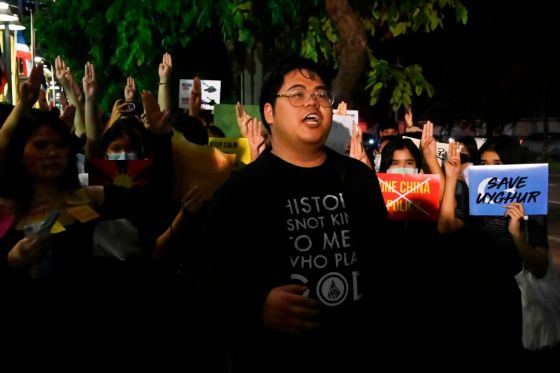
In Thailand, demonstrators have chanted “Free Hong Kong,” and waved Hong Kong democracy and Taiwan independence flags. In Taipei, activists, dissidents and students have gathered to show their support for the Thai protests.
On Hong Kong’s LIHKG, a Reddit-like platform used by protesters, threads have highlighted the benefits of cross-promotion. Hongkongers can support Thai protesters’ without being subject to harsh lèse majesté laws that criminalize defamation of the king, and Thai protesters can promote Hong Kong’s struggle without facing potential repercussions under a draconian new national security law.
“The idea is that we can speak for each other’s values within a relatively safer environment,” says Ted Hui, a Hong Kong pro-democracy lawmaker who organized an Oct. 19 rally outside the Thai consulate in support of Thai protesters.
Other politicians have taken notice. Taiwan’s vice president has used the hashtag, as has the spokesperson from India’s ruling Bharatiya Janata Party (BJP).
“I think this kind of pan-Asian collaboration and solidarity will just enhance the unity of the youth movements and also help China realize their soft power expansion and Wolf Warrior diplomacy is not working,” says prominent Hong Kong activist Joshua Wong.
The alliance, he tells TIME, has vast potential to expand. “If anyone believes in democracy and freedom and is against the authoritarian crackdown, they could also recognize themselves as part of the Milk Tea Alliance.”
Read more: Meet the Lawyer Trying to Reform the Thai Monarchy
What is the Milk Tea Alliance?
The hashtag #MilkTeaAlliance first sprang up on Twitter in April, to counter attacks by pro-Beijing trolls and bots on a Thai celebrity perceived to have slighted China. Actor and teen idol Vachirawit Chivaaree, known as “Bright,” had liked a tweet showing four different cities, including Hong Kong, with a caption that referred to them as “countries.” (Hong Kong is a semi-autonomous territory but being under Chinese sovereignty is not independent.)
Soon, he was bombarded by the kind of jingoistic outrage normally reserved for foreign brands like the N.B.A., Apple and Gap that have irked Beijing. In Bright’s case, patriotic Chinese social media users surmounted the country’s internet firewall to correct the record on Hong Kong’s status.
His apology failed to mollify the internet horde. They dug up more geopolitical offenses in social media accounts belonging to his girlfriend, Weeraya “Nnevvy” Sukaram, including an Instagram post that appeared to suggest the independence of self-ruled democratic Taiwan, which China considers part of its territory.
Bright and Nnevvy’s fans shot back with humorous memes and other counterattacks. Then, the Chinese trolls misfired: they focused their criticism on the Thai government, economy and monarchy, much to the delight of young Thai social media users who enthusiastically agreed. Hong Kong and Taiwanese users started chiming in too, sensing an ideological affinity with the Thais in the fight against autocracy and Beijing’s Twitter army.
“The authoritarian Thai government has censored us for decades … and now certain Chinese nationalists are trying to use [Chinese Communist Party] CCP propaganda to tell us what we can and cannot think about Hong Kong and Taiwan. That’s unacceptable to those of us who believe in freedom of thought and speech,” the Taiwan Alliance for Thai Democracy, a group of Thai students living in Taiwan, stated in an email to TIME.
Once the Chinese Embassy in Bangkok weighed in with a statement insisting “the recent online noises only reflect bias and ignorance,” the resistance solidified.
“While the movement started as a trend, state opposition to it has turned it into a cohesive movement for change which is spreading beyond young people alone,” says Paul Chambers, a Thai politics expert at Naresuan University’s College of Asean Community Studies.
What are the goals of the Milk Tea Alliance?
The preparation of milk tea varies in Thailand (where a food dye gives it its signature bright terracotta color), Hong Kong (where a combination of Sri Lankan black tea and tea dust give it extra potency), and Taiwan (where the addition of tapioca pearls was popularized). In similar fashion, the political struggles in each of these places have their own characteristics.
In Thailand, students have taken to the streets demanding fresh elections under a new constitution, as well as curbs to the powerful monarchy’s prerogatives. In Hong Kong, protesters fear the loss of their city’s political freedoms under an ever-encroaching Beijing. And in Taiwan, activists are anxious over the CCP’s pledge to reunify the island by force if necessary.
Yet each of these struggles also share in the existential battle between democracy and dictatorship.
“I think the alliance proves that democracy is a universal [not just Western] value,” says Tattep “Ford” Ruangprapaikitsere, one of the Thai protest organizers. “Democracy is the only form of government that gives the opportunity for all people to fulfill their dreams.”
Asian activists have also found a common adversary in Beijing—a key ally of Thailand’s military-aligned government.
“The milk tea alliance could potentially turn into a genuine transnational anti-authoritarian movement—a rejection of the Chinese authoritarian model,” says Roger Huang, a politics lecturer at Sydney’s Macquarie University. “There may be some repercussions for China: governments could justify any backlash against China’s more aggressive actions in the region by citing popular opinion.”
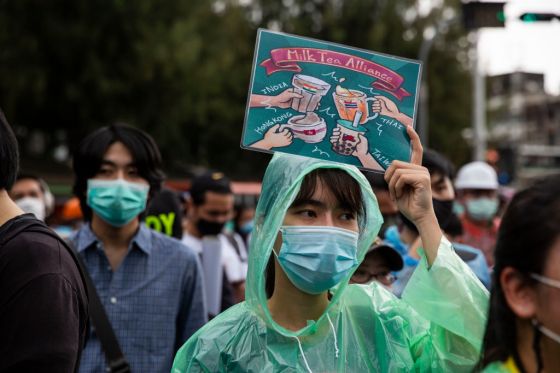
The coalition has come into existence as negative views of China reach fresh highs in many advanced economies, according to a recent Pew Research Center survey. While the coronavirus pandemic—which emerged in China late last year—caused a reputational hit, recent trade and diplomatic disputes with neighboring countries have also prompted anger.
According to Sitthiphon Kruarattikan, director of the Institute of East Asian Studies at Bangkok’s Thammasat University, the formation of the Milk Tea Alliance “reflects that China is still unsuccessful in cultivating soft power or winning hearts and minds of their Taiwan compatriots and neighboring countries.”
What does China say about the Milk Tea Alliance?
China’s foreign ministry has dismissed the coalition. “People who are pro-Hong Kong independence or pro-Taiwan independence often collude online, this is nothing new. Their conspiracy will never succeed,” spokesman Zhao Lijian told Reuters.
But supporters of the alliance say they are not anti-Chinese per se—instead they are simply finding affinity in their shared pursuit of liberal democracy.
Joshua Wong, in Hong Kong, insists the aim goes beyond opposition to any one country. “It’s not about being anti-Chinese government only, but [about] anti-authoritarian rule everywhere,” he says.
Read more: Why This Thai Billionaire Is Risking It All to Back Reform
Activists say the outpouring of solidarity makes them feel less alone in their struggle. Social media has also made it much easier for like-minded protesters to band together and find strength in numbers, says Veronica Mak, a sociology professor at Hong Kong Shue Yan University.
“The young people know that their political capital is weak because they don’t have money, and not many of them have political connections. But they have found support and political resonance online,” she says, and that has given them more influence.

Their camaraderie has also opened up a vital pipeline for sharing tactics.
“[We’re] not only talking, we’ve also gotten a lot of knowledge and information from the movement in Hong Kong,” says Ford, the Thai protest organizer.
From tips on staying safe on the barricades to extinguishing smoking tear gas canisters and conducting leaderless rallies that melt away before police can effectively counterattack, Hong Kong has exported its decentralized protest techniques around the world. Activists in the United States, Catalonia, Nigeria and Indonesia have all borrowed from Hong Kong’s playbook.
Some supporters of the Milk Tea Alliance see an opening to join forces across all these movements.
“Injustice anywhere is a threat to justice everywhere,” self-exiled Hong Kong activist Nathan Law recently tweeted, quoting Martin Luther King while expressing support for Thailand and the Milk Tea Alliance.
And while the alliance remains a fledgling movement for now, it has potential for growth.
“We are connected via these common dreams,” says Netiwit Chotiphatphaisal, a prominent Thai activist. “It empowers us to have more energy to fight.”

New world news from Time: No Matter Who Wins the U.S. Election, Relations With China Are at a Crossroads
In a speech last week to commemorate 70 years since China’s entry into the Korean War, President Xi Jinping launched a thinly-veiled attack on the U.S. “No blackmailing, blocking or extreme pressuring will work” for those seeking to become “boss of the world,” Xi told veterans and cadres crammed into Beijing’s Great Hall of the People. The 1950-53 Korean War, he went on, “broke the myth that the U.S. military is invincible.”
With U.S.-China relations at a decades-long nadir, it was fitting that Xi threw down the gauntlet on the anniversary of one of the only times the People’s Liberation Army and U.S. troops have faced off on the battlefield—a conflict still known in China as the “War to Resist U.S. Aggression and Aid Korea.”
The upcoming U.S. election on Nov. 3 could be a turning point for American foreign policy, particularly regarding Beijing, which has borne the brunt of the Trump Administration’s sledgehammer approach to diplomacy. Chinese trade practices, tech companies, diplomats and even students have been in the crosshairs, feeding Beijing’s paranoia that the U.S. is pursuing a Soviet-era policy of containment.
Much hangs in the balance: economics, nuclear proliferation, the climate crisis, human rights as well as possible military confrontations. Whether Donald Trump or Joe Biden controls the White House may decide if the last four years of rancor was an aberration or the new normal for relations between the world’s top two economies.
“China, of course, is very concerned about the election,” says Wang Yiwei, director of the Institute of International Affairs at Renmin University in Beijing. “If Biden wins, he may take a multilateral approach, more coherence with U.S. alliances. If Trump wins, he’ll definitely continue harsh policies toward China.”
But whoever sits in the Oval Office in January, a return to fulsome engagement appears off the table.

Global rivalry between the U.S. and China
Washington’s attempts to isolate Beijing from an integrated and interconnected global economy have forced U.S. companies to relinquish established supply chains in China. Senior administration hawks like Secretary of State Mike Pompeo have also openly questioned the legitimacy of the Chinese Communist Party (CCP) and called for regime change.
As a result, the U.S. is losing the goodwill of ordinary Chinese, with moderate voices within society replaced by resurgent nationalism. Meanwhile, the vacuum created by the Trump Administration’s America First approach has allowed Beijing to co-opt international institutions. China now sits on the U.N. Human Rights Council despite detaining one million Muslims in its far west region of Xinjiang. It champions the Paris Climate Accords and free trade despite, being the world’s worst polluter and propping up key industries with state funds.
This has allowed China to develop a narrative that it is reasserting its rightful place in global leadership while the U.S is in terminal decline—riven by income inequality, political polarization, racial injustice and toxic nativism. That has been strengthened this year by Trump’s inability or unwillingness to tackle the COVID-19 pandemic in the U.S. while China has successfully controlled the coronavirus within its borders and is the only major economy heading for growth this year.
At the same time, China has torpedoed some of its relationships around the world as it seeks to swell its influence. When the normally urbane Foreign Minister Wang Yi visited Europe late August—ironically to smooth trade tensions—he threatened Norway with reprisals were it to give the Nobel Peace Prize to Hong Kong protesters, and swore that the president of the Czech senate would pay a “heavy price” for visiting the self-ruled island of Taiwan, which China regards as a breakaway province. (The affront prompted the Mayor of Prague to brand Chinese diplomats “rude clowns.”) On Oct. 21, China responded to Sweden’s decision to ban Huawei from its 5G network by threatening a “negative impact” on Swedish companies.

China’s military capability
Worryingly, Beijing’s hawkish Wolf Warrior diplomacy has gone beyond rhetoric and strayed into saber-rattling with U.S. allies. In recent months, China has ramped up military drills around Taiwan, sailed a record number of sorties into Japan’s territorial waters and engaged in deadly Himalayan border clashes with India. This appears to be more than mere chest-thumping; analysts suspect that China may be pitting its formidable yet untested military against unprepared foes in order to better gauge its own capabilities as well as the likelihood of an international backlash.
“India is a perfect target because it’s not a treaty ally of anybody,” says John Pomfret, a former Beijing bureau chief for the Washington Post and author of The Beautiful Country and the Middle Kingdom: America and China, 1776 to the Present. “You push the Indians around a little bit, declare victory and leave. That would signal the rest of the world that China’s big and bad and can do this type of stuff so watch out.”
Beijing insists that it is the victim of Indian aggression in the recent Himalayan skirmishes. But it is less meek about designs for Taiwan, which split politically from the mainland following China’s 1927-1949 civil war and is by far the CCP’s most coveted prize. Xi considers reuniting the island with the mainland a historic “mission” and analysts agree it is the most likely issue to force a military confrontation between the superpowers.
Read more: How TikTok Found Itself in the Middle of a U.S.-China Tech War
In an Oct. 10 speech, Taiwan President Tsai Ing-wen called for “reconciliation and peaceful dialogue” with Beijing. Instead, Beijing responded within hours by releasing previously unseen footage of a large-scale military exercise simulating the invasion of an unidentified island, as well as video of a staged confession from a Taiwanese businessman charged with spying on the mainland.
Oriana Skylar Mastro, a specialist on China’s military at Stanford University’s Freeman Spogli Institute for International Studies, says that up until 2015 the main consideration of Chinese military leaders was Washington’s resolve to defend Taiwan. Now, however, she says they tell her: “It doesn’t matter. We would still win.”
The veracity of those sentiments is a matter of hot debate, but concerningly, “China has a remarkable tendency to overestimate its power,” says Pomfret. In September, the PLA Air Force released a video on its official social media showing nuclear-capable H-6 bombers carrying out a simulated raid on what looks like Andersen Air Force Base on the U.S. Pacific island of Guam. In a clear reference to U.S. support for Taiwan, Xi told the Great Hall of the People last week that any attempt to invade or separate China’s “sacred territory” will be met “with a head-on blow!”

Sino-U.S. relations after the election
It’s a precarious situation in need of deft diplomacy. Some China hawks in the Trump Administration are calling for Taiwan to be provided with an explicit U.S. defense guarantee. But that would be “provocative and expensive,” says Benjamin H. Friedman, policy director for the nonpartisan Defense Priorities think tank. “I’m not in favor.”
Trump’s distaste for multinational institutions like NATO, and dislike of U.S. troop deployments overseas, has made America’s allies take their own security more seriously. On Monday, the U.S. State Department approved the sale of 100 Boeing-made Harpoon Coastal Defense Systems to Taiwan in a deal worth as much as $2.37 billion, prompting China to impose sanctions on the U.S. companies involved.
“Taiwan could do more, Japan could do more,” says Friedman. “They could buy more defensive systems, particularly mobile missiles and radar that will make it harder to be invaded.”
Biden, by contrast, has voiced support for a multilateral approach in the region, restoring America’s role in global governance and re-establishing a liberal democratic order. Writing on Oct. 22 in World Journal, America’s largest Chinese-language newspaper, Biden vowed to “stand with friends and allies to advance our shared prosperity and values in the Asia-Pacific region … That includes deepening our ties with Taiwan, a leading democracy, major economy, technology powerhouse—and a shining example of how an open society can effectively contain COVID-19.”
Biden has railed against Trump’s trade war—which studies estimate has trimmed 0.7% from U.S. GDP—and would likely rollback many tariffs. He also said that he would organize and host a global Summit for Democracy to “renew the spirit and shared purpose of the nations of the free world” during his first year in office.
Read more: What Happens Next With the U.S.-China Rivalry
Reasserting such historic alliances could cause Beijing much heartburn. “We are 25% of the world’s economy,” Biden told the audience at the final presidential debate Oct. 23. “We need to have the rest of our friends with us saying to China, ‘These are the rules, you play by them or you will pay the price for not playing by them, economically.’”
While there’s no doubt that Biden would be tougher on China than Obama, many in diplomatic circles hope he could reopen lines of communication with Beijing to seek pragmatic solutions on trade, the environment, human rights and other issues. America still has many tools. The dollar’s role as global reserve currency has become more important during the pandemic. And the U.S. still boasts the world’s biggest economy, spearheading innovation.
But the U.S. has never faced a rival that can compete economically and militarily as China can. In the week before his Korean War anniversary speech, Xi addressed the nation on state-run television: “We Chinese know well we must speak to invaders with the language they understand,” he said. “So we use war to stop war, we use military might to stop hostility, we win peace and respect with victory. In the face of difficulty or danger, our legs do not tremble, our backs do not bend.”

New top story from Time: ‘We Share the Ideals of Democracy.’ How the Milk Tea Alliance Is Brewing Solidarity Among Activists in Asia and Beyond
On China’s National Day this year, Thai student Bunkueanun “Francis” Paothong performed a song outside the Chinese embassy in Bangkok. “Arise! Ye who would not be slaves again,” a video posted on Twitter showed him operatically singing into the humid evening.
The words famously open China’s national anthem, “The March of the Volunteers.” But they also appear in “Glory to Hong Kong”—the unofficial anthem of Hong Kong’s democracy movement—and it was this that Francis was singing at the Oct. 1 protest. “For Hong Kong, may glory reign!” he intoned.
Written and composed anonymously last year, the song has come to represent Hong Kong’s youth-driven rebellion against Beijing. But its four stanzas are now also sung in Thailand where protesters against the military-backed government and the monarchy are not only adopting tactics of resistance from their Hong Kong counterparts but are also cross-promoting causes.
Though their demands may be different, solidarity between the movements has been building for months. Activists have now joined forces in a so-called “Milk Tea Alliance,” a loose, transnational network of youth who see themselves as engaged in similar fights against authoritarianism and who have mostly come of age amid China’s growing influence in the region.
Named for a beverage popular in Thailand, Hong Kong and Taiwan, the #MilkTeaAlliance was forged in the crucible of a meme war in April that pitted Chinese nationalists against democratically minded young people in those places. But it has since spilled into something bigger.
“In each of our countries we face different issues, but when it comes down to it, we share the ideals of democracy,” Francis tells TIME.
Online, the hashtag has been used to push a boycott of Disney’s remake of Mulan and to raise awareness about China’s human rights abuses in Xinjiang and Tibet. Offline, the solidarity its has inspired has increasingly driven real-world action.
In Thailand, demonstrators have chanted “Free Hong Kong,” and waved Hong Kong democracy and Taiwan independence flags. In Taipei, activists, dissidents and students have gathered to show their support for the Thai protests.
On Hong Kong’s LIHKG, a Reddit-like platform used by protesters, threads have highlighted the benefits of cross-promotion. Hongkongers can support Thai protesters’ without being subject to harsh lèse majesté laws that criminalize defamation of the king, and Thai protesters can promote Hong Kong’s struggle without facing potential repercussions under a draconian new national security law.
“The idea is that we can speak for each other’s values within a relatively safer environment,” says Ted Hui, a Hong Kong pro-democracy lawmaker who organized an Oct. 19 rally outside the Thai consulate in support of Thai protesters.
Other politicians have taken notice. Taiwan’s vice president has used the hashtag, as has the spokesperson from India’s ruling Bharatiya Janata Party (BJP).
“I think this kind of pan-Asian collaboration and solidarity will just enhance the unity of the youth movements and also help China realize their soft power expansion and Wolf Warrior diplomacy is not working,” says prominent Hong Kong activist Joshua Wong.
The alliance, he tells TIME, has vast potential to expand. “If anyone believes in democracy and freedom and is against the authoritarian crackdown, they could also recognize themselves as part of the Milk Tea Alliance.”
Read more: Meet the Lawyer Trying to Reform the Thai Monarchy
What is the Milk Tea Alliance?
The hashtag #MilkTeaAlliance first sprang up on Twitter in April, to counter attacks by pro-Beijing trolls and bots on a Thai celebrity perceived to have slighted China. Actor and teen idol Vachirawit Chivaaree, known as “Bright,” had liked a tweet showing four different cities, including Hong Kong, with a caption that referred to them as “countries.” (Hong Kong is a semi-autonomous territory but being under Chinese sovereignty is not independent.)
Soon, he was bombarded by the kind of jingoistic outrage normally reserved for foreign brands like the N.B.A., Apple and Gap that have irked Beijing. In Bright’s case, patriotic Chinese social media users surmounted the country’s internet firewall to correct the record on Hong Kong’s status.
His apology failed to mollify the internet horde. They dug up more geopolitical offenses in social media accounts belonging to his girlfriend, Weeraya “Nnevvy” Sukaram, including an Instagram post that appeared to suggest the independence of self-ruled democratic Taiwan, which China considers part of its territory.
Bright and Nnevvy’s fans shot back with humorous memes and other counterattacks. Then, the Chinese trolls misfired: they focused their criticism on the Thai government, economy and monarchy, much to the delight of young Thai social media users who enthusiastically agreed. Hong Kong and Taiwanese users started chiming in too, sensing an ideological affinity with the Thais in the fight against autocracy and Beijing’s Twitter army.
“The authoritarian Thai government has censored us for decades … and now certain Chinese nationalists are trying to use [Chinese Communist Party] CCP propaganda to tell us what we can and cannot think about Hong Kong and Taiwan. That’s unacceptable to those of us who believe in freedom of thought and speech,” the Taiwan Alliance for Thai Democracy, a group of Thai students living in Taiwan, stated in an email to TIME.
Once the Chinese Embassy in Bangkok weighed in with a statement insisting “the recent online noises only reflect bias and ignorance,” the resistance solidified.
“While the movement started as a trend, state opposition to it has turned it into a cohesive movement for change which is spreading beyond young people alone,” says Paul Chambers, a Thai politics expert at Naresuan University’s College of Asean Community Studies.
What are the goals of the Milk Tea Alliance?
The preparation of milk tea varies in Thailand (where a food dye gives it its signature bright terracotta color), Hong Kong (where a combination of Sri Lankan black tea and tea dust give it extra potency), and Taiwan (where the addition of tapioca pearls was popularized). In similar fashion, the political struggles in each of these places have their own characteristics.
In Thailand, students have taken to the streets demanding fresh elections under a new constitution, as well as curbs to the powerful monarchy’s prerogatives. In Hong Kong, protesters fear the loss of their city’s political freedoms under an ever-encroaching Beijing. And in Taiwan, activists are anxious over the CCP’s pledge to reunify the island by force if necessary.
Yet each of these struggles also share in the existential battle between democracy and dictatorship.
“I think the alliance proves that democracy is a universal [not just Western] value,” says Tattep “Ford” Ruangprapaikitsere, one of the Thai protest organizers. “Democracy is the only form of government that gives the opportunity for all people to fulfill their dreams.”
Asian activists have also found a common adversary in Beijing—a key ally of Thailand’s military-aligned government.
“The milk tea alliance could potentially turn into a genuine transnational anti-authoritarian movement—a rejection of the Chinese authoritarian model,” says Roger Huang, a politics lecturer at Sydney’s Macquarie University. “There may be some repercussions for China: governments could justify any backlash against China’s more aggressive actions in the region by citing popular opinion.”
The coalition has come into existence as negative views of China reach fresh highs in many advanced economies, according to a recent Pew Research Center survey. While the coronavirus pandemic—which emerged in China late last year—caused a reputational hit, recent trade and diplomatic disputes with neighboring countries have also prompted anger.
According to Sitthiphon Kruarattikan, director of the Institute of East Asian Studies at Bangkok’s Thammasat University, the formation of the Milk Tea Alliance “reflects that China is still unsuccessful in cultivating soft power or winning hearts and minds of their Taiwan compatriots and neighboring countries.”
What does China say about the Milk Tea Alliance?
China’s foreign ministry has dismissed the coalition. “People who are pro-Hong Kong independence or pro-Taiwan independence often collude online, this is nothing new. Their conspiracy will never succeed,” spokesman Zhao Lijian told Reuters.
But supporters of the alliance say they are not anti-Chinese per se—instead they are simply finding affinity in their shared pursuit of liberal democracy.
Joshua Wong, in Hong Kong, insists the aim goes beyond opposition to any one country. “It’s not about being anti-Chinese government only, but [about] anti-authoritarian rule everywhere,” he says.
Read more: Why This Thai Billionaire Is Risking It All to Back Reform
Activists say the outpouring of solidarity makes them feel less alone in their struggle. Social media has also made it much easier for like-minded protesters to band together and find strength in numbers, says Veronica Mak, a sociology professor at Hong Kong Shue Yan University.
“The young people know that their political capital is weak because they don’t have money, and not many of them have political connections. But they have found support and political resonance online,” she says, and that has given them more influence.
Their camaraderie has also opened up a vital pipeline for sharing tactics.
“[We’re] not only talking, we’ve also gotten a lot of knowledge and information from the movement in Hong Kong,” says Ford, the Thai protest organizer.
From tips on staying safe on the barricades to extinguishing smoking tear gas canisters and conducting leaderless rallies that melt away before police can effectively counterattack, Hong Kong has exported its decentralized protest techniques around the world. Activists in the United States, Catalonia, Nigeria and Indonesia have all borrowed from Hong Kong’s playbook.
Some supporters of the Milk Tea Alliance see an opening to join forces across all these movements.
“Injustice anywhere is a threat to justice everywhere,” self-exiled Hong Kong activist Nathan Law recently tweeted, quoting Martin Luther King while expressing support for Thailand and the Milk Tea Alliance.
And while the alliance remains a fledgling movement for now, it has potential for growth.
“We are connected via these common dreams,” says Netiwit Chotiphatphaisal, a prominent Thai activist. “It empowers us to have more energy to fight.”
