TORONTO — Prime Minister Justin Trudeau said Monday it ’s not an isolated incident that over 200 children were found buried at a former Indigenous residential school.
Trudeau’s comments come as Indigenous leaders are calling for an examination of every former residential school site — institutions that held children taken from families across the nation.
Chief Rosanne Casimir of the Tk’emlups te Secwepemc First Nation in British Columbia said the remains of 215 children, some as young as 3 years old, were confirmed this month with the help of ground-penetrating radar. She described the discovery as “an unthinkable loss that was spoken about but never documented” at the Kamloops Indian Residential School, the largest such school in the country.
[time-brightcove not-tgx=”true”]
“As prime minister, I am appalled by the shameful policy that stole Indigenous children from their communities,” Trudeau said.
“Sadly, this is not an exception or an isolated incident,” he said. ‘’We’re not going to hide from that. We have to acknowledge the truth. Residential schools were a reality — a tragedy that existed here, in our country, and we have to own up to it. Kids were taken from their families, returned damaged or not returned at all.”
From the 19th century until the 1970s, more than 150,000 First Nations children were required to attend state-funded Christian schools as part of a program to assimilate them into Canadian society. They were forced to convert to Christianity and not allowed to speak their native languages. Many were beaten and verbally abused, and up to 6,000 are said to have died.
The Canadian government apologized in Parliament in 2008 and admitted that physical and sexual abuse in the schools was rampant. Many students recalled being beaten for speaking their native languages. They also lost touch with their parents and customs.
Indigenous leaders have cited that legacy of abuse and isolation as the root cause of epidemic rates of alcoholism and drug addiction on reservations.
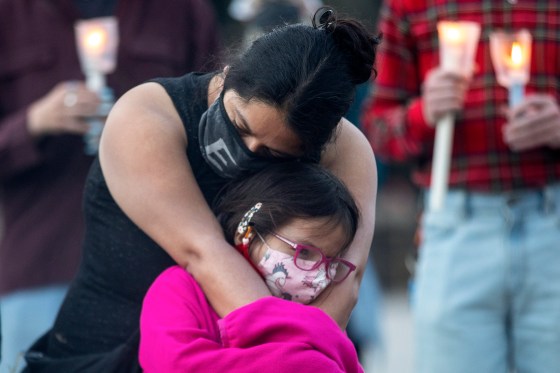
Chris Young/The Canadian Press via APA mother hugs her daughter during a vigil in Toronto on Sunday May 30, 2021, for the 215 Indigenous children, whose remains were uncovered on the grounds of a former residential school near Kamloops, British Columbia.
Plans are underway to bring in forensics experts to identify and repatriate the remains of the children found buried on the Kamloops site.
Trudeau said he’ll be talking to his ministers about further things his government needs to do to support survivors and the community. Flags at all federal buildings are at half-staff.
Opposition New Democrat leader Jagmeet Singh called Monday afor an emergency debate in Parliament.
“This is not a surprise. This is a reality of residential schools,” Singh said.
“215 Indigenous kids were found in an unmarked mass grave,” he said. ‘’Anytime we think about unmarked mass graves, we think about a distant country where a genocide has happened. This is not a distant country.”
The Kamloops school operated between 1890 and 1969, when the federal government took over operations from the Catholic Church and operated it as a day school until it closed in 1978.
Richard Gagnon, archbishop of Winnipeg and president of the Canadian Conference of Catholic Bishops, said he wanted to express “our deepest sorrow for the heartrending loss of the children at the former Kamloops Indian Residential School.”
The National Truth and Reconciliation Commission has records of at least 51 children dying at the school between 1915 and 1963. The Commission identified about 3,200 confirmed deaths at schools but noted the schools did not record the cause of death in almost half of them. Some died of tuberculosis. The Commission said the practice was not to send the bodies of the students who died at the schools to their communities. The Commission also said the government wanted to keep costs down so adequate regulations were never established.
“This discovery is a stain on our country. It is one that needs to be rectified,” Opposition Conservative lawmaker Michelle Rempel Garner said.
Empty pairs of children’s shoes have been placed at memorials throughout the country.
Perry Bellegarde, chief of the Assembly of First Nations, has said while it is not new to find graves at former residential schools, it’s always crushing to have that chapter’s wounds exposed.
The Federation of Sovereign Indigenous Nations and the Saskatchewan government said they want Ottawa to help research undocumented deaths and burials at residential schools in the province.
Federation Chief Bobby Cameron said finding the children’s remains and giving them proper burials is important to help First Nations communities and families find closure. The federation has compiled a list of initial sites where it hopes to complete radar ground searches.
Sol Mamakwa, an opposition lawmaker with the New Democrat party in Ontario, also called on the government to search the grounds of other former residential schools.
“It is a great open secret that our children lie on the properties of former schools. It is an open secret that Canadians can no longer look away from,” he said.
For Itzel Schnaas, a 31-year-old professional ballet dancer in Mexico City, going public was her insurance policy. If the plan worked, she believed a world-famous public intellectual, with ties to Mexico’s government and major media conglomerates, would be exposed as a sex offender, and she could be protected from him and his powerful friends. They couldn’t go after her if the world was watching, especially if other women came forward too. On Feb. 15, she posted a nearly seven-minute YouTubevideoexcoriating the man: “It turns out that I had barely been born when you started violating women and sowing fear to obtain their silence, you miserable a–hole,” she says in Spanish. “You ought to be scared of us. Because I am certain that many other women are going to add their accusations to this one.”
[time-brightcove not-tgx=”true”]
They did.
Since then, 36 womenhave publicly accusedAndrés Roemer, leveling charges of sexual harassment, abuse and rape on social media and in the press. At least six have formally accused the 57-year-old before the Mexico City prosecutor’s office, Mexico City’s attorney general confirmed on May 24. In February, UNESCO stripped him of his Goodwill Ambassador title, and Columbia University, where he was a visiting scholar, cut ties with him. On May 5, amid reports that Roemer was in Israel, a Mexico City judge issued a warrant for his arrest for rape. His assets were frozen the same day. On May 21, Mexico City’s attorney general announced that a second warrant for Roemer’s arrest had been issued and that her office was preparing an extradition request from Israel. Roemer has denied the accusations. “I have never raped, assaulted, threatened or used any type of violence against any woman,” he said in a statement to Radio Formula on May 6. Roemer’s assistant did not make him available for comment for this story.
“Itzel Schnaas’ video changed everything,” says María Scherer, a journalist who started investigating rumors about abuse by Roemer years ago when, she says, it was still an open secret. Roemer’s alleged crimes are comparable in scope and style to those of Harvey Weinstein. Like the former film producer, Roemer’s power and status—cemented by friendships with the likes of former Mexican President Vicente Fox and billionaire Ricardo Salinas Pliego, both witnesses at his 2018 wedding—helped ensure his alleged victims’ silence. He also benefited from a legal system that practically guarantees impunity: according to onestudy, only 5% of sexual abuse or rape cases in Mexico end in a sentence. “It’s very hard to get proof like a video, medical evidence or something that proves the aggression,”saysViridiana Valgañón, a lawyer with Mexican women’s-rights organization Equis.“You come face to face with the machinery of patriarchal justice, because your word, as a female victim, is doubted at every turn.”
For years, Roemer’s accusers chipped away at the wall of silence that protects men, and especially powerful men, in a country where neither feminism nor the movement against gender violence had yet gone mainstream. When Schnaas roared her accusation, it was amplified by their efforts, and taken up on social media and WhatsApp to create a community of previously siloed victims. Now, an open secret hasbecome an international political scandal.
For Roemer, the beginning of the endstarted with his flagship project.La Ciudad de las Ideas—known in English as the Festival of Brilliant Minds, a conference similar to TED Talks, has been held nearly every November since 2008 in Puebla, in east-central Mexico. (The 2020 festival was pushed to December by COVID-19.) For four days, some of the world’s most innovative thinkers, including Michio Kaku, Christopher Hitchens, Werner Herzog and Alain de Botton, would debate ideas before an audience of thousands. It’s become a cultural touchstone, into which the state of Puebla has injectedat least $17 millionsince 2007. Roemer, the festival’s founder and curator, is constantly on the move, dashing across the whale-shaped dome that hosts the event to moderate a panel, introduce a speaker or emcee. He is the literal face of the festival: in a three-minute 2020 promotionalvideo, Roemer appears at least 17 times.
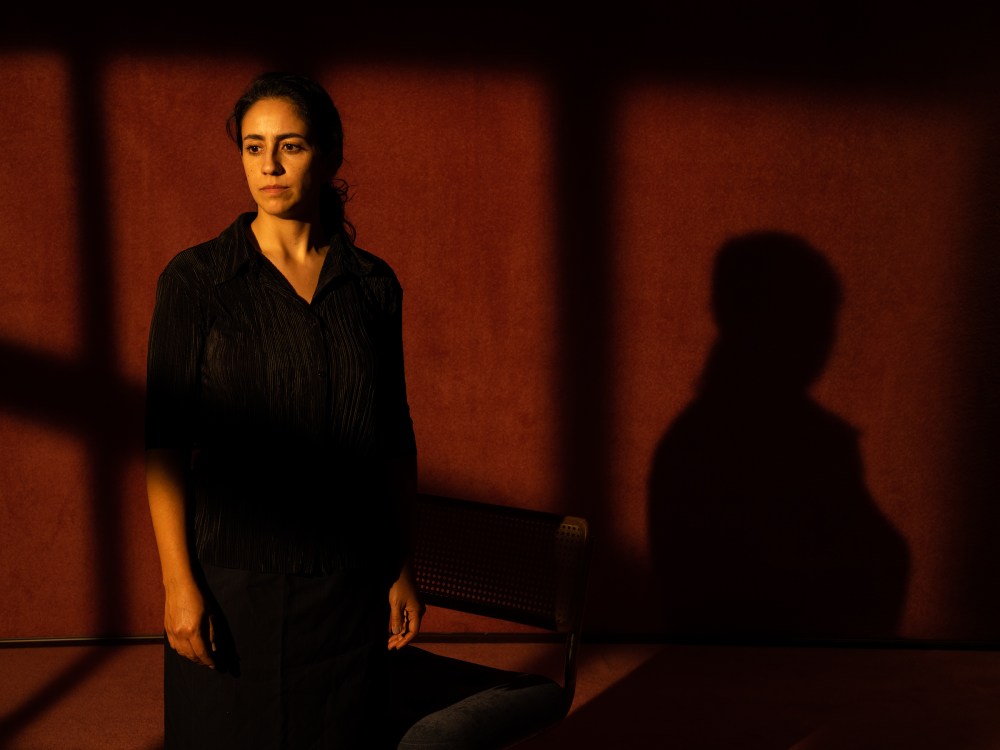
Tania Franco Klein for TIMEItzel Schnass photographed in Mexico City on May 24.
In her own video, and in interviews with TIME, Schnaas set out her account of her dealings with Roemer—one sharply disputed by Roemer himself. As Schnaas describes it, they first met in 2019 backstage at the festival, where Mexico’s upper crust, including billionaire Salinas, Roemer’s friend and the owner of media conglomerate Grupo Salinas that sponsors the festival, milled about eating canapés and drinking wine proffered by waiters in formal attire. Schnaas’ father is an architect and a judge for the Mexican Sailing Federation, an elite club whose members include some of Mexico’s wealthiest citizens. This was a familiar world to her, albeit one she regards with a degree of ironic detachment. (At 18, as a rising star in Mexican ballet, she had tossed her tiaras and tutus aside in favor of contemporary dance and a philosophy degree.) At the urging of mutual acquaintances, Schnaas and Roemer exchanged numbers to discuss a potential artistic collaboration for the following year’s festival. They set a date to meet later that month.
<b>“It was clear to me. …I didn’t know what I was going to do yet, but I knew I was going to do it.”</b>According to Schnaas, that’s when Roemer started acting strangely. He changed their meeting’s location at the last minute from a restaurant to a place he did not disclose as his home. After Schnaas arrived at a large stone house in the Mexico City neighborhood of Roma, a domestic worker ushered her into a room whose function seemed to fall somewhere between library, movie theater and lounge. When Roemer entered, what Schnaas had expected to be a professional meeting then soon devolved into farce. Roemer incessantly interrupted her to comment on her physique, how sexy he thought dancers were and how much he wished he’d married one. She says she felt a combination of shock and repulsion when, she says, he stroked her legs and masturbated, finally pulling out a wad of cash and instructing her to buy an expensive dress “for the next time.”
When he let her out of the house, Schnaas says she tore away on her motorcycle in a fury.She was well versed in handling and deflecting men’s unwanted advances. “I was a girl who grew up in a world of dance where, when you were 10 or 15 years old, choreographers would tell you that until you had a certain amount of sexual experience, you wouldn’t be an artist,” she says. But something about Roemer’s brazenness—and a strong suspicion she was not the first, nor the worst treated—compelled her to take action.“It was clear to me. I knew he was a f-cking rapist. I didn’t know what I was going to do yet, but I knew I was going to do it,” she says.
Since Grupo Salinas sponsored the Festival of Brilliant Minds and Roemer hosted his own show on the company’s network, it made sense to strike there. She told a friend of her father’s who worked there what had happened, and asked for his help getting the word out. But when the coronavirus pandemic hit Mexico in March 2020, her grievance took a backseat. She persisted until finally, in November 2020, Schnaas says the company’s Gender Unit—an office created a year earlier to address reports of sexual harassment and violence—agreed to open a case. Schnaas says that during an in-person meeting in December 2020, the director of the unit described Roemer as a “serial aggressor,” but said that since Schnaas was not an employee at Grupo Salinas, they could not take legal steps. The director of the Gender Unit declined to comment to TIME. The director of editorial strategy at Grupo Salinas said that though the Gender Unit was made aware of Schnaas’ case, no investigation was carried out.
So Schnaas looked outside the company. She turned to a feminist collective, the United Mexican Journalists (PUM), which had spearheaded a #MeToo campaign in Mexican media in March 2019. She had been feeling discouraged and starting to doubt whether her experience even warranted her efforts, but her resolve returned when the collective informed her that they’d named Roemer in accusations published on Twitter. They were only three among 242 total #MeToo accusations PUM had posted at the time, and did not include the names of the accusers, but reading them, Schnaas could hardly believe how close they hewed to her own experience: business meetings meant to take place in a public setting and then, at the last minute, moved to Roemer’s home. His promises to jump-start their careers. She was heartbroken byone in particular, in which a young woman claimed Roemer had raped her after pulling the same moves in 2017. “If I hadn’t read the previous #MeToo accusations and seen that the exact same thing had happened before, I would have probably minimized or discredited my own story,” she says. PUM suggested Schnaas pen a fourth accusation. She wanted to film a video instead. And she wanted to publish it in February. “I wanted this to be a f-cking bomb for March 8,” she says.
The 2020 International Women’s Day in Mexico City—mere weeks before lockdown measures halted public life—had been epic, one of the largest protests globally that day, and the largest protest of any kind in Mexico in recent memory. In the last few years, the women’s-rights movement, centering around demands to address a skyrocketing femicide epidemic in the face of the state’s inaction, had rapidly bloomed in Mexico, and Schnaas wanted to capitalize on the momentum.
On Feb. 9, she took to Facebook, posting: “Last year I denounced Dr. Roemer, Andrés Isaac Roemer Slomianski is an abuser.” Two days later, Schnaas received a WhatsApp message from a woman named Lidia Camacho. She was a friend of Roemer’s, and wanted to talk. They met for coffee, and over the course of several other meetings over the next few days, Camacho pleaded Roemer’s case and asked Schnaas to meet with him to talk it out.
On the morning of Feb. 14, Schnaas and Roemer met in a café with witnesses in tow: Camacho and Javier Contreras, Schnaas’ friend and achoreographer at Mexico’s National Institute of Fine Arts and Literature.Schnaas read Roemer the script she planned to read in the video she was planning to make soon. She wore the same pale blue collared dress she’d worn two years earlier, the first time they’d met—she liked the symmetry.Contreras, Schnaas’ witness, says Roemer pleaded with her not to post the video, and attempted to dissuade her by arguing that “different kinds of narratives may exist for the same event,” citing as an example the 1950 filmRashomon,which, through multiple narratives, questions the notion of a single truth. Roemer then gave Schnaas a set of books, includingThe Secret Lives of Men and Women—a compilation of postcards containing racy musings such as, “I sit in meetings and imagine who likes it rough.”
Roemer’s account of his dealings with Schnaas is quite different. In a later tweet, he wrote he “seriously” denied the abuse allegation and said he and Schnaas talked it out during their Feb. 14 meeting.
For Schnaas, nothing was resolved. Meeting over, she says she raced to the home of her longtime friend and fellow dancer Ricardo Encinas, and told him to grab his camera and start rolling. In a furious but steady voice, she read the same text she had just delivered to Roemer. She says it felt like she was still reading to him. She posted the video the next day, and the messages started pouring in.
Women across Mexico and as far as San Francisco and New York got in touch with Schnaas via Facebook and Instagram, most with stories of misconduct concerning Roemer. They’d exchange numbers and call. “I’m talking about two-hour-long calls late at night, crying, total catharsis,” Schnaas says. Over a month and a half, Schnaas says she fielded about 80 calls. Most simply wanted to talk and weren’t sure about going public with their stories. But a few, like Talia Margolis, were ready.
Margolis, a 32-year-old communications manager, says she met Roemer in 2009. She was a volunteer at a Jewish community center and was working on a project to award scholarships to teens to attend the Brilliant Minds festival. A few weeks after seeing him give a talk at his office, she was out walking with a friend when she spotted him seated at a café and approached to say hello. After briefly chatting, Roemer proposed that she drop by his house to interview for a position with the festival. Margolis thought this was a golden opportunity and accepted. Meeting in his home did not strike her as a concern. He was a trusted member of the Jewish community and she felt safe. On the appointed day, she sat in the entertainment room as Roemer asked about her studies and described the festival. Then—out of the blue, as she recalls it—he complimented her on her breasts, and later asked if she was clean-shaven in her pubic area. She cut the meeting short and left, feeling utterly humiliated. She never heard back about the job.
In 2019, when #MeToo hit, Margolis says she decided to publicly share her experience and got in touch with journalistMaríaScherer who was investigating Roemer for a podcast on his alleged behavior. She sat for an interview, but Scherer had to drop the project after other women backed out, and Margolis was left without an outlet until shesaw Schnaas’ video on Feb. 15.She reached out to Schnaas, and they talked about what they should do next. “I told myself, ‘This can’t end here,’” Margolis says. On Feb. 18, when she had PUM publish her ownstatement,Margolisbecame the fifth person to publicly accuse Roemer, after Schnaas and the three anonymous women from 2019. That same day, Monserrat Ortiz came forward.
<b>“She described things that were so similar to what happened to me. I told myself, ‘Now is the time.'”</b>Ortiz, a 27-year-old journalist, met Roemer in 2017. She had been working for TV Azteca, Grupo Salinas’ flagship media company, as a TV reporter for six months when she was assigned to interview Roemer about the festival. After finding her on Facebook a few days afterward, Roemer messaged with a work proposal involving some translation and writing and suggested he make a reservation somewhere for them to discuss it. Ortiz was dying to write—that was the reason she’d gotten into journalism in the first place—and she figured the gig might open doors. Besides, she could use the money. She accepted. But on the day of the meeting, she says Roemer sent her a message with a change of plans. He sent a chauffeur to drive her to a new location, which ended up being his house. After being ushered into the entertainment room, she says Roemer locked the door behind them. Then, while insistently staring at her legs, she says he came out with a completely different job proposal from the one he’d originally pitched: a game-show hostess. She replied that she wasn’t interested; she was a journalist. She tried to steer the conversation back to the original offer. But without warning, she says, he started masturbating in front of her, and then raped her. When he was done, she says he pulled out some cash and told her to buy an expensive dress for their next meeting. She also says he told her that if she uttered a word about that evening, he would make sure she never got hired in media again. Afraid Roemer would make good on his threat, Ortiz kept quiet about the incident. (Roemer told El País he denies Ortiz’s rape allegation and said he does not know her.)
In March 2019, when PUM started publishing#MeToo accusations on Twitter, Ortizwrote astatementabout the alleged assault and asked the collective to post it anonymously. (She was still working for TV Azteca.) It was the statement that, nearly two years later, convinced Schnaas to make the video. Ortiz spotted it while scrolling through her social media feeds on Feb. 18.“She described things that were so similar to what happened to me. I told myself, ‘Now is the time,'” she says, and wrote another, more detailedstatementand asked PUM to publish it,this time with her name. Then she wrote Schnaas.
Suddenly headline news across Mexico, Margolis, Schnaas and Ortiz created a WhatsApp group to be in touch through the media storm, and to collectively manage the flood of messages they were now all receiving from other women claiming to have been abused by Roemer. Most were still afraid to come out publicly. But they ended up getting a push from an unlikely place.
On Feb. 20, Roemer posted his ownvideo. Sitting before a bookshelf, he introduced himself and claimed to have information that would clear up his and Schnaas’ now public dispute. He then aired a four-minute clip of a recording he took during their Feb. 14 meeting. In it, Schnaas could be heard telling Roemer that when she approached Grupo Salinas in November 2019, she defended him before two of her father’s friends who worked there, who had it out for him. (Schnaas later explained to me that what she meant was her issue with Roemer was separate from their internal political feuds.) “As you can see, behind this accusation are the interests of two people who do not belong to the women’s-rights movement,” Roemer concludes.
But far from deflecting the issue, Roemer’s video backfired. “To me, that’s when he dug his own grave,” says Diana Murrieta, the president and founder of Nosotras Para Ellas, an NGO providing free legal counsel and psychological assistance to victims of gender-based violence. “It created a collective fury.” Murrietta says a handful of Roemer’s alleged victims had reached out to her organization after Schnaas’ video, but that those numbers soared after Roemer posted his own.
On Twitter, PUM started publishing daily, sometimes twice daily, statements by women accusing Roemer of sexual misconduct. Mariana Flores, a 33-year-old contractor who also says Roemer lured her to his house under the guise of a work offer in 2011, then touched and kissed against her will, was one of the women pushed over the edge by Roemer’s denial. She sent PUM her statement on Feb. 20 and asked them topublishit with her name.“I had two options. Either I resigned myself to the fact that this was going to be my life, that I was going to have to endure this kind of behavior, or I joined this group of women who said we could build a different world. I told myself, I’m with them,” Flores says now.
Tania Franco Klein for TIMEMariana Flores photographed in Mexico City on May 24.
Soon the WhatsApp group included over a dozen women. It was a refuge where they could feel a sense of camaraderie, and ease each other’s anxieties. And soon their boldness paid off:On Feb. 23, 2021, in an extremely rare move,the Mexico City prosecutor’s office opened an investigation ex officio into Roemer, based on the news reports of his alleged crimes. Finally, a legal path was open for the women to pursue Roemer. The next day, he deleted his Twitter account.
“Two or three years ago, when women accused Roemer of these crimes, the authorities did not open a case. But this time, they did,” says Ximena Ugarte, a lawyer with the Mexican Human Rights and Democracy Institute representing a group of women accusing Roemer. The Mexico City prosecutor’s office did not respond to requests for comment. Ugarte attributes the change to new policy that’s helped facilitate sex crime investigations in the capital, notably a 2019 “Gender-Based Violence Alert,” but also to Mexico’s feminist movement. “This is a fight that women have been waging for a long time,” she says.
<b>“We’re creating a monster against this man.”</b>It’s also a fight that has been waged on multiple fronts. Emails shared with TIME show that in 2019, Roemer was reported for sexual harassment to the UNESCO Director-General, but that requests for an investigation were ignored. UNESCO declined to comment on the emails.
The number of Roemer’s accusers kept growing, bringing actors, writers, academics, public servants and hotel maids to a common front. On March 2, some finally met for the first time when they recorded Scherer’s podcast.In the days leading up to March 8, Roemer barricaded his house: large black boards covered the first and second stories. They didn’t stop women who, as Schnaas had hoped and predicted, gathered before Roemer’s house on International Women’s Day, tore down one of the boards to scale the second floor and—in pink and purple spray paint—write “rapist” and “abuser” next to a large French window.
“We’re creating a monster against this man,” Ortiz says.
The pursuit is now international. On May 7, several survivors of Roemer’s alleged abuse wrote aletterto the Israeli ambassador in Mexico, asking for cooperation in Roemer’s extradition. “We want to make sure no more women suffer the horrors we live with,” they wrote.
The original WhatsApp group eventually splintered. Some of the women opted out of accusing him before the prosecutor’s office, fearing possible fallout on their families or careers. Others formed smaller groups around the different lawyers they chose to represent them.
All of that is understandable to the women who first pushed the case into the public square. Margolis says, “If I’m scared, and he only sexually harassed me, I can’t even imagine how the women who were assaulted must feel.”
Schnaas says some days she wakes up feeling certain more women will join them in formally accusing Roemer. Other days feel so taxing she can’t believe anyone else would put themselves through it. She reminds herself that the united front they created outed him to the world. “We’re already a huge case,” she says.
While they wait for justice, the support of the sisterhood has fortified some of the first accusers. Flores finally found the courage to talk with her therapist about her experience with Roemer, which she says she had not done in five years of therapy.Ortiz overcame the panic attacks she’d been suffering for weeks. Now, she’s focusing on her work: writing about gender-based violence.
BEIJING — China’s ruling Communist Party will ease birth limits to allow all couples to have three children instead of two to cope with the rapid rise in the average age of its population, a state news agency said Monday.
The ruling party has enforced birth limits since 1980 to restrain population growth but worries the number of working-age people is falling too fast while the share over age 65 is rising, adding to strains on the economy and society.
A meeting Monday of the party’s Politburo decided “China will introduce major policies and measures to actively deal with the aging population,” the Xinhua News Agency said.
[time-brightcove not-tgx=”true”]
Party leaders “pointed out that further optimizing the fertility policy, implementing the policy of one couple can have three children and supporting measures are conducive to improving China’s population structure,” the report said.
It gave no details on when or how the change would be carried out.
China’s population of 1.4 billion already was expected to peak later this decade and start to decline. Census data released May 11 suggest that is happening faster than expected, straining underfunded pension and health systems and cutting the number of future workers available to support a growing retiree group.
Restrictions that limited most couples to one child were eased in 2015 to allow all to have two. But after a brief rise the next year, births declined. Couples say they are put off by the cost of having children, disruption to jobs and the need to look after their own parents.
The share of working-age people 15 to 59 in the population fell to 63.3% last year from 70.1% a decade earlier, according to the census data. The group aged 65 and older grew to 13.5% from 8.9%.
The 12 million births reported last year was down nearly one-fifth from 2019.
About 40% were second children, down from 50% in 2017, according to Ning Jizhe, a statistics official who announced the data on May 11.
CAIRO — Egypt and Israel held high-level talks in both countries Sunday to shore up a fragile truce between Israel and the Hamas militant group and rebuild the Gaza Strip after a punishing 11-day war that left parts of the seaside enclave in ruins.
Egyptian Foreign Minister Sameh Shukry received his Israeli counterpart, Gabi Ashkenazi, in Cairo. The meeting is part of an effort to build on an Israel-Hamas cease-fire reached May 21 and to revive Israeli-Palestinian negotiations, which have been dormant for more than a decade, Shukry’s office said. Egypt has not said how it would be able to restart talks.
[time-brightcove not-tgx=”true”]
The hours-long visit was the first public one by an Israeli foreign minister to Egypt since 2008, according to the Israeli Embassy in Cairo.
Spokesman Ahmed Hafez said Shukry called for establishing an atmosphere to relaunch “serious and constructive” negotiations between the two sides. He also urged both sides to refrain from “any measures” that could hamper efforts to revive peace talks.
They also discussed the release of Israeli soldiers and citizens being held by Hamas, Israel’s top diplomat said.
“We all need to act to prevent strengthening extremist elements that threaten regional stability, and to ensure the return home of the missing persons and prisoners held by Hamas,” Ashkenazi said.
He also criticized the Palestinian Authority over its moves at the International Criminal Court and the U.N. Human Rights Council, saying such activity damages the chances of future cooperation.
Ashkenazi alleged that Palestinian war crimes complaints against Israel —filed over its military conduct since a 2014 war with Hamas and ongoing settlement construction — are an obstacle to political dialogue. The ICC is investigating both Israel and Hamas for possible war crimes. Hamas is under investigation for random rocket fire toward Israeli communities.
Despite cease-fire talks, Hamas and the smaller militant group Islamic Jihad have staged weapons parades in a show of force. On Sunday, thousands attended a Hamas rally in the northern Gaza town of Beit Lahiya, where masked militants displayed rockets, launchers and drones.
Hamas is holding the remains of two Israeli soldiers killed in a 2014 war. It also is holding two Israeli civilians who were captured after entering Gaza.
As part of the cease-fire efforts, Israeli Prime Minister Benjamin Netanyahu hosted Abbas Kamel, Egypt’s intelligence chief, in Jerusalem. Netanyahu said he had raised the issue of returning the remains of soldiers and the two civilians as well as Israeli demands to prevent Hamas from gaining strength or diverting resources meant for the civilian population.
An Egyptian official said Kamel would also meet with Palestinian officials in the West Bank before heading to Gaza for talks with Hamas leaders. The intelligence agency, which is Egypt’s equivalent of the CIA, usually handles Egypt’s ties with Hamas and other Palestinian militant groups in Gaza.
Egypt’s state-run MENA news agency said Kamel would convey a message from el-Sissi to Palestinian President Mahmoud Abbas, affirming “Egypt’s full support to the Palestinian people.”
It said Cairo would host talks among Palestinian factions to achieve unity between those in Gaza and the Israeli-occupied areas of the West Bank. The report did not provide further details.
During a visit to the region last week, Secretary of State Antony Blinken said he was seeking to bolster Abbas and weaken Hamas as part of the cease-fire efforts.
Hamas seized control of the Gaza Strip from Abbas’ forces in 2007, leaving the internationally recognized Palestinian Authority in charge of administering autonomous zones in some 40% of the Israeli-occupied West Bank. Hamas, which refuses to recognize Israel’s right to exist, is branded a terrorist group by Israel, the U.S. and other Western countries.
Discussions with Israeli officials have touched on a set of measures that would allow materials, electricity and fuel into the territory, as well as the possible expansion of maritime space allowed for Gaza fishermen, the Egyptian official said.
“The role of the Palestinian Authority is central in the talks,” he said. “Egypt is seeking to have it deeply involved in the reconstruction process.”
The Egyptian official, who had close knowledge of the proceedings that led to the cease-fire, spoke on condition of anonymity because he wasn’t allowed to brief reporters.
The 11-day war killed more than 250 people, mostly Palestinians, and caused heavy destruction in the impoverished coastal territory. Preliminary estimates have put the damage in the hundreds of millions of dollars. Egypt was key in mediating a deal between the two sides.
The official said Egypt has offered guarantees that rebuilding funds will not find its way to Hamas, possibly going through an international committee led by Egypt or the United Nations that would oversee the spending.
Kamel has also discussed the situation in Jerusalem and ways to ease tensions in the holy city. That would include understandings at the Al-Aqsa Mosque, where Israeli police repeatedly clashed with Palestinian demonstrators, and how to prevent the planned eviction of Palestinian families from the Sheikh Jarrah neighborhood in east Jerusalem, the official said.
Hamas leader Ismail Haniyeh is expected to visit Cairo this week, according to the group’s spokesman Abdelatif al-Qanou, who also said Hamas is open to discussing a prisoner swap with Israel.