By Simon Romero from NYT U.S. https://nyti.ms/3j9dV5p

Saturday, July 31, 2021
‘This Isn’t How We’re Supposed to Live’: Residents Flee as Dixie Fire Surges
By Simon Romero from NYT U.S. https://nyti.ms/3j9dV5p
She just won her third gold medal in Tokyo. Detractors in South Korea are criticizing her haircut.

By Yu Young Jin from NYT Sports https://nyti.ms/2TMbOfb
Here’s Who Is Hospitalized for Covid in New York City as Cases Rise

By Sharon Otterman from NYT New York https://nyti.ms/2VcCoyT

Simone Biles withdraws from floor final at Tokyo Olympics
American Simone Biles withdraws from the floor final but is yet to make a decision on whether to compete on beam.
from BBC News - World https://bbc.in/3C4EEJa
from BBC News - World https://bbc.in/3C4EEJa
Simone Biles criticism baffles Callum Skinner: Mental health 'not death of sport'
Criticism of Simone Biles for withdrawing from some events at Tokyo 2020 is "baffling", says Olympic gold medallist Callum Skinner.
from BBC News - World https://bbc.in/3ycgrOF
from BBC News - World https://bbc.in/3ycgrOF
Tokyo Olympics: Charlotte Worthington wins BMX freestyle gold for Great Britain
Great Britain's Charlotte Worthington wins a thrilling gold in the women's BMX park freestyle Olympic final.
from BBC News - World https://bbc.in/2V8BGTf
from BBC News - World https://bbc.in/2V8BGTf
Anti-eviction lawmaker camps overnight on US Capitol steps
Cori Bush fears millions of US tenants could be at risk if an eviction freeze is allowed to expire.
from BBC News - World https://bbc.in/3j3IYj4
from BBC News - World https://bbc.in/3j3IYj4
Nairobi - the centre of East Africa's thriving arts scene
Artists from across East Africa have converged on Kenya's capital, creating a vibrant scene.
from BBC News - World https://bbc.in/3zVw11t
from BBC News - World https://bbc.in/3zVw11t
The women fighting infertility stigma in Nigeria
Three Nigerian women confront the prejudice they have faced on their fertility journeys.
from BBC News - World https://bbc.in/3lhcnsF
from BBC News - World https://bbc.in/3lhcnsF
Kris Wu: K-Pop star arrested on suspicion of rape
The Chinese-Canadian star denies allegations made online by several women in China.
from BBC News - World https://bbc.in/3xfV4uz
from BBC News - World https://bbc.in/3xfV4uz
SolarWinds: Top US prosecutors hit by suspected Russian hack
It is feared hackers may have accessed sensitive legal files during last year's SolarWinds breach.
from BBC News - World https://bbc.in/3C3hy5J
from BBC News - World https://bbc.in/3C3hy5J
Double GB gold in new mixed events
Great Britain kick off a golden Saturday by winning two of the new mixed relay events but there is disappointment for Dina Asher-Smith.
from BBC News - World https://bbc.in/379x2H5
from BBC News - World https://bbc.in/379x2H5
Navy Charges Sailor With Arson in Fire That Destroyed Warship

By John Ismay from NYT U.S. https://nyti.ms/2V2SkDU
Tokyo Olympics: Elaine Thompson-Herah defends 100m title
Elaine Thompson-Herah became the second-fastest woman in history as she beat fellow Jamaican Shelly-Ann Fraser-Pryce to defend her Olympic 100m title.
from BBC News - World https://bbc.in/3ifgxzn
from BBC News - World https://bbc.in/3ifgxzn
Tokyo Olympics: The medal winners' flowers that pay tribute to 2011 disaster
More than 5,000 bouquets are being handed to athletes at the Olympic and Paralympic Games - and have a special significance, with flowers from areas devastated by a 2011 earthquake and tsunami.
from BBC News - World https://bbc.in/2VmKPr0
from BBC News - World https://bbc.in/2VmKPr0
Dressel sets world record to win third Tokyo gold
American Caeleb Dressel gains his third gold medal of the Tokyo Olympics with a 100m butterfly world record, while Katie Ledecky and Kaylee McKeown also win golds.
from BBC News - World https://bbc.in/3ldSRgH
from BBC News - World https://bbc.in/3ldSRgH
Tokyo Olympics: Georgia athletes removed from Games after sightseeing trip
Two Georgian silver medallists are told to leave the Olympic Games for taking a sightseeing trip in Tokyo.
from BBC News - World https://bbc.in/3fgqjPS
from BBC News - World https://bbc.in/3fgqjPS
ICYMI: Decoding feline feelings and a breathtaking bungee jump
A round-up of the week's news you might have missed.
from BBC News - World https://bbc.in/3zWQ7IU
from BBC News - World https://bbc.in/3zWQ7IU
Afghanistan: Fighting rages as Taliban besiege three key cities
Fears rise of a humanitarian crisis as Islamist militants seek to capture major Afghan urban areas.
from BBC News - World https://bbc.in/2V9cY51
from BBC News - World https://bbc.in/2V9cY51
Billie Eilish opens up on internet trolls
Eilish tells Amfo of her frustration with internet criticism in a new documentary to be broadcast on Saturday.
from BBC News - World https://bbc.in/37cEb9C
from BBC News - World https://bbc.in/37cEb9C
Tokyo Olympics: Novak Djokovic loses to Pablo Carreno Busta in bronze-medal match
Novak Djokovic throws one racquet and smashes another as his bid for an Olympic medal ends in defeat by Spain's Pablo Carreno Busta.
from BBC News - World https://bbc.in/3j9YJF8
from BBC News - World https://bbc.in/3j9YJF8
Simone Biles, struggling with ‘the twisties,’ says she can’t ‘tell up from down.’

By Juliet Macur from NYT Sports https://nyti.ms/3lhD6Ft
Friday, July 30, 2021
The man who 'killed' Pluto
How Mike Brown’s discovery of a larger object threatened Pluto’s 75-year status as a planet
from BBC News - World https://bbc.in/3j5zMeb
from BBC News - World https://bbc.in/3j5zMeb
Donald Trump ordered to hand over tax returns to Congress
The ruling is a big legal blow to the ex-president, who has not publicly disclosed his tax returns.
from BBC News - World https://bbc.in/3fa8kuz
from BBC News - World https://bbc.in/3fa8kuz
Bob Odenkirk: Better Call Saul actor thanks supporters after heart attack
The Better Call Saul star says he had a "small heart attack" on Tuesday and is going to be okay.
from BBC News - World https://bbc.in/3j9oUvw
from BBC News - World https://bbc.in/3j9oUvw
Woman charged for disturbing Yellowstone mother grizzly
A woman faces wildlife endangerment charges for a close call with a mother grizzly in Yellowstone.
from BBC News - World https://bbc.in/3j8HHam
from BBC News - World https://bbc.in/3j8HHam
Russia stops Cubans trying to enter EU by air bed
Three Cubans caught trying to cross a river into Estonia are said to have been heading for Spain.
from BBC News - World https://bbc.in/3lcFLjM
from BBC News - World https://bbc.in/3lcFLjM
Trump Pressed Justice Dept. to Declare Election Results Corrupt, Notes Show

By Katie Benner from NYT U.S. https://nyti.ms/37f2eo4
Amanda Knox claims Matt Damon film Stillwater profits from her life
The director of Stillwater said he was fascinated by Ms Knox's wrongful murder conviction in Italy.
from BBC News - World https://bbc.in/3zR61o3
from BBC News - World https://bbc.in/3zR61o3
Kenya's President Uhuru Kenyatta criticises 'vaccine nationalism'
Kenya’s President Uhuru Kenyatta says vaccine nationalism is why he wants his country to move towards vaccine production.
from BBC News - World https://bbc.in/3yigGaQ
from BBC News - World https://bbc.in/3yigGaQ

Deadly oil tanker attack in Arabian Sea
Two crew members, a British and a Romanian citizen, are killed in an incident off the coast of Oman.
from BBC News - World https://bbc.in/3xeVL7x
from BBC News - World https://bbc.in/3xeVL7x
Tokyo Olympics: Who are the contenders for Usain Bolt's 100m crown?
For the first time since 2004 an athlete other than Usain Bolt will win the men's Olympic 100m - but who are the contenders for gold?
from BBC News - World https://bbc.in/3jlznV9
from BBC News - World https://bbc.in/3jlznV9
‘They Thought I Was Dead’: Haitian President’s Widow Recounts Assassination

By Frances Robles from NYT World https://nyti.ms/3fg5SCH
Amazon hit with $886m fine for alleged data breach
The tech giant rejects claims it has broken European Union data protection laws.
from BBC News - World https://bbc.in/3rK1Tn9
from BBC News - World https://bbc.in/3rK1Tn9

Australia to return 14 artworks of disputed provenance to India
The National Gallery says their repatriation will "close a very difficult chapter of our history".
from BBC News - World https://bbc.in/3rGmx7A
from BBC News - World https://bbc.in/3rGmx7A
China nuclear: Taishan reactor shut down over damaged fuel rods
The operator says the EPR reactor at Taishan in China is "under control" despite fuel rod concerns.
from BBC News - World https://bbc.in/3BVtoPd
from BBC News - World https://bbc.in/3BVtoPd
Critics praise 'defiant' Billie Eilish album
The teen megastar's second album, Happier Than Ever, gives an unflinching portrayal of global fame.
from BBC News - World https://bbc.in/3BWFXto
from BBC News - World https://bbc.in/3BWFXto
ابن القذافي ما زال حيا ويريد أن يستعيد ليبيا

By Robert F. Worth from NYT Magazine https://nyti.ms/3fePAKh
Scarlett Johansson Sues Disney Over ‘Black Widow’ Release

By Brooks Barnes and Nicole Sperling from NYT Business https://nyti.ms/3if5kyI
New world news from Time: Tunisia’s President Staged What Looks Like a Coup. But Democracy Isn’t Dead There Yet
In recent years, Tunisia has become a victim of its own reputation. In the decade since its landmark 2011 revolution, its characterization as “the only democratic success story of the Arab Spring” has hung around the country’s neck like an albatross.
While observers have routinely celebrated its “democratic transition” they overlooked a parliament that regularly descended into chaos and a flailing economy. Into this mix, factor in the worst of the COVID-19 pandemic and the government’s catastrophic response to it, and an event like the one that occurred Sunday—when President Kais Saied suspended the country’s legislature and dismissed unpopular Prime Minister Hichem Mechichi—becomes almost inevitable.
[time-brightcove not-tgx=”true”]
Few saw Saied’s intervention coming. Nevertheless, late on Sunday evening, following what had at times been violent demonstrations across the country, with protesters calling for the dissolution of parliament and early elections, among other things, the President acted.
Quoting Article 80 of the Constitution, he suspended the parliament for 30 days and removed its members’ immunity from prosecution. While the legality of this move remains the source of fierce debate, his seriousness was never open to doubt. “I warn any who think of resorting to weapons… and whoever shoots a bullet,” he said, “the armed forces will respond with bullets.”
Why the President felt he had to act
The desire for change in Tunisia has been brewing. Under the rule of the last ten governments to oversee Tunisia during the past decade, a political class has risen that is seen as entirely unmoored to the sometimes brutal reality of daily Tunisian life. Last year, as a government survey found that one-third of households feared they would run out of food, Tunisia’s politicians considered abolishing bread subsidies. Through riots over unemployment, economic desperation, hunger and police brutality, Tunisia’s politicians and government ignored the struggles of a desperate country and concentrated on political theatrics and positioning.
There was nothing contrived about the celebrations that greeted the news of the President’s intervention. In Tunis, excited crowds debated the news, while simultaneously trying to define exactly what it meant. Still, the enthusiasm has held in the days since. On the streets of Intilaka, a working class neighbourhood near Tunis that has frequently hosted clashes between the police and angry youths, residents on Tuesday applauded the President’s intervention. Some looked forward to the speedy reinstatement of a reformed institution, others were happy to be ruled by what they saw as the benevolent dictator of the presidential palace at Carthage.
Boubaker Guesmi, a 56-year-old local, shares this view. Unemployed for more than a decade, his only income was the 180 dinars ($64.50) he received from the state each month. From this and his wife’s part-time income, the couple have to feed and clothe themselves and their three daughters. He says he has few misgivings about the President’s intervention or fears of a return to the autocratic days of ousted President Zine El Abidine Ben Ali and his kleptocratic government, “I don’t think Kais Saied will be another Ben Ali. He’s clean, [not corrupt],” he said through a translator. As for a theoretical future free from parliament, Guesmi approves of the idea. “Now if I ask for something from the government, I know that they will answer,” he says. Saied has said that he would assume executive authority with the assistance of a new prime minister.
Concerns about corruption remain a source of frustration for many Tunisians in Intilaka. “All politicians are corrupt,” one young man said. That perception does not seem to extend to Saied, though, who remains extremely popular. According to a poll conducted by Emrhod Consulting, published on Wednesday night, 87% of the 900 Tunisians surveyed supported the President. Only 3% opposed him. His popularity isn’t newfound. In the second round run-offs of 2019’s presidential election, the former law professor and political novice registered a tally just shy of the total number of votes cast for parliament, in which the self-styled “Muslim Democrats” Ennahda emerged as the largest party. His star may have dimmed a little since then but, by contrast, the parliament’s star has plummeted.
A coup or ‘the will of the people’?
In the days since the President’s intervention, the online debate over what it signifies rages on. In the absence of firm evidence one way or another, his detractors call Saied’s move a coup and have branded his backers putschists and anti-democratic, accusing them of being on the payroll of France, the UAE and Egypt. Saied’s supporters claim their critics are Islamists, arguing instead that the President has acted upon the will of “the people.”
It’s true that the resistance to Saied’s intervention has been led by Ennahda, the Islamist party. However, not all critics of the President’s intervention are Islamists. Such accusations are also unlikely to endear the President and his supporters to Tunisia’s international backers, such as the E.U. and U.S., which he desperately needs to keep on side. Nevertheless, labelling all critics of the President as Islamists remains a useful tool.
For many in contemporary Tunisia, to call an opponent an Islamist is to question their integrity and malign their motives. For Ennahda, an exemplar of the Islamist philosophy in Tunisia, it has been a steep fall since the giddy peaks of 2011. Over the last ten years, Ennahda has maintained a presence in nearly all of Tunisia’s ten governments of various stripes. In doing so, it has found itself partnered with some unlikely bedfellows, profoundly undermining both Ennahda’s credibility and that of its political partners.
Perceptions that Ennahda is out of touch with the everyday struggles of many Tunisians helped fuel protests on Sunday and led to many of the party’s offices being vandalised. “They’re just out for themselves,” says 33-year-old Mohamed Ali from the border town of Ben Guerdane. “It’s not just about politics, it’s about jobs,” he says, referring to the perception that regional Ennahda officials distribute jobs to party members ahead of the local populace.
Public disenchantment with Ennahda has made it easy for rivals to scapegoat them, even when they themselves are as much to blame for disrupting the function of parliament. Abir Moussi, the leader of the Parti Destourien Libre (PDL), which was founded by members of the ruling party pre-revolution, is one lawmaker who has been quick to blame Ennahda and their more extreme Islamist allies, Al Karama, for disruptions they now deny having caused. Moussi herself was the victim of a horrific violent assault by an Islamist Deputy associated with Al Karama.
She has also arguably done more to disrupt parliamentary order than any other politician. In the past, her stunts have included turning up parliament in a bullet proof vest and crash helmet, calling out opposition deputies with a megaphone and staging numerous sit-ins to protest the Islamists’ presence in the chamber. She was quick to voice support for the President, posting a video 24 hours after Saied’s intervention wishing him the best in “realizing the aspirations of the citizens and restoring the foundations of the State.”
Democracy in Tunisia is still at risk
If Saied is to maintain the moral high ground in Tunisia, it will be important that he doesn’t circumvent the political process for too long. He has said parliament’s suspension is temporary. His own mandate is a democratic one and therefore no more or less legitimate than parliament’s—and no matter how problematic a parliament is, it’s best dismissed with ballots, not threats of bullets. An intervention like Saied’s puts Tunisia’s democracy at acute risk. But for now, Tunisia’s politically aware and hugely invested civil society groups have not raised the alarm, instead holding their counsel and watching events closely.
However, if Saied deviates from his constitutionally couched assurances on Sunday night, he risks jeopardizing not only the vital support he needs from the hugely influential Tunisian trade union, the UGTT, but also the country’s international backers.
Secretary of State Antony Blinken spoke with the President on Monday and “encouraged President Saied to adhere to the principles of democracy and human rights that are the basis of governance in Tunisia,” his office said in a statement. Other prominent voices in the U.S. were more critical. Writing in the Washington Post, Republican Senator Lindsey Graham called for the U.S. and its allies to go “all in” on Tunisia, including being “on the ground.” On social media, Connecticut Democratic senator Chris Murphy questioned the role that the United Arab Emirates and Saudi Arabia may be playing in Tunisia. Within Washington’s thinktanks, the response was no less furious. Shadi Hamid, a senior fellow at the nonpartisan Brookings Institution’s Center for Middle East Policy called for the suspension of all U.S. aid to Tunisia. To many within Tunisia, the response from the international community appears bizarre. On social media, accusations of colonialism dominated the discourse.
Despite the concerns among foreign onlookers, democracy isn’t dead in Tunisia. But it is at risk. The next 30 days will prove crucial to the path the country takes. If a roadmap out of the current mess isn’t drawn up by then, the country risks a parliament being restored that holds its citizens in contempt, setting the country up for a period of instability few wish to see again.

Turkey fires: Blazes threaten Marmaris and other coastal resorts
Villages and hotels are evacuated as firefighters attempt to put out dozens of blazes.
from BBC News - World https://bbc.in/3jkAHHR
from BBC News - World https://bbc.in/3jkAHHR
Djokovic's 'golden Grand Slam' bid thwarted
Novak Djokovic's hopes of winning a 'Golden Slam' are over after losing to Alexander Zverev in the Olympic tennis semi-finals.
from BBC News - World https://bbc.in/3yg1r2n
from BBC News - World https://bbc.in/3yg1r2n
Covid-19 pandemic: Japan widens emergency over 'frightening' spike
The Olympics host is facing record Covid case numbers, fuelled by the virulent Delta strain.
from BBC News - World https://bbc.in/3lkmq02
from BBC News - World https://bbc.in/3lkmq02
Thursday, July 29, 2021
Dressage: How to make a horse dance
For some, it's an oddity to watch only at the Olympics... for others, it's a lifetime of training.
from BBC News - World https://bbc.in/3rIVYib
from BBC News - World https://bbc.in/3rIVYib
Tokyo Olympics: Novak Djokovic thrashes Kei Nishikori to reach men's semi-finals
Novak Djokovic remains on course for a 'Golden Slam' after thrashing home hope Kei Nishikori to ease into the Olympic semi-finals.
from BBC News - World https://bbc.in/3faR5ci
from BBC News - World https://bbc.in/3faR5ci
Tokyo Olympics: How to think like a champion
Newsbeat speaks to Bill Beswick, the psychologist behind the 26-year-old breaststroke star.
from BBC News - World https://bbc.in/3rJLrTW
from BBC News - World https://bbc.in/3rJLrTW
The separated refugees brought back together by judo
Sanda Aldass and Muna Dahouk have trained together since childhood but the war in Syria separated them.
from BBC News - World https://bbc.in/3xbniXh
from BBC News - World https://bbc.in/3xbniXh
Olympics: The hidden sight of Tokyo's homeless
For many among Tokyo's homeless community the Olympics are far from a cause for celebration.
from BBC News - World https://bbc.in/3BPiri9
from BBC News - World https://bbc.in/3BPiri9
Covid-19: Biden tells states to offer $100 vaccine incentive as cases rise
The US president also announced that all federal workers must be vaccinated or subjected to testing.
from BBC News - World https://bbc.in/3iWRY9E
from BBC News - World https://bbc.in/3iWRY9E
First group of evacuated Afghan interpreters arrives in US
The evacuations are part of Operation Allies Refuge as the US military mission in Afghanistan ends.
from BBC News - World https://bbc.in/37aTKi6
from BBC News - World https://bbc.in/37aTKi6
Scarlett Johansson sues Disney over streaming of Black Widow
The star says box office takings for Black Widow were hit when it was streamed at the same time.
from BBC News - World https://bbc.in/3lanYK1
from BBC News - World https://bbc.in/3lanYK1
Theodore McCarrick: Defrocked US cardinal charged with assault and battery
Theodore McCarrick is believed to be the highest-ranking US Catholic to face criminal abuse charges.
from BBC News - World https://bbc.in/2UTVA4t
from BBC News - World https://bbc.in/2UTVA4t
New world news from Time: Climate Disasters Are Making It Hard to Enjoy the Olympics. And I’m Not Sure I Want to, Anyway
A version of this story first appeared in the Climate is Everything newsletter. If you’d like sign up to receive this free once-a-week email, click here.
As the U.S. approached a coronavirus peak last July, a noticeably eerie Disney World reopening advertisement began making the rounds online. Cases were rising, driven by a false sense of security in much of the country and bad faith arguments around masking and social distancing. But at Disney World, the sun was shining, and rides were open. Low-paid service workers waved while wearing surgical masks, apparently thrilled (or at least willing) to come in contact with crowds of tourists braving the pandemic for a spot on the Pirates of the Caribbean ride.
[time-brightcove not-tgx=”true”]
Often, rather than reassuring us, such mass recreations of normalcy in the midst of a disaster can deepen our sense of unease, because they reveal an unsettling truth: the people who should take responsibility either don’t understand how bad things are, or do not care.
Watching the Olympics this year amid endless, compounding climate disasters has given me pangs of that pandemic-at-Disney-World feeling. It’s not that the Olympic organizers aren’t trying, at least in some sense. They’ve made great strides to conduct this summer’s Games sustainably, using renewable energy to light their arenas, for instance, and offsetting the event’s emissions with carbon credits, while a lack of international spectators (and reduced team staffing) eliminates the climate toll of jetting hundreds of thousands of people to Tokyo. One could say that this year’s Olympics offers a measure of hope from a climate perspective, demonstrating how huge, inspiring events might be conducted sustainably in the years ahead.
But then there’s that gut feeling that, following once-in-a-thousand-year floods in China’s interior, unprecedented wildfires raging in Siberia, and a heatwave in the Pacific Northwest so intense as to nearly defy scientific understanding, something about the international spectacle playing out in Tokyo isn’t right.
For one thing, it’s clear that climate change will make it increasingly difficult to host such events. Expected conditions in Tokyo were hot enough that organizers moved the Olympic marathon almost 500 miles north to avoid televised scenes of world-class runners collapsing from heat exhaustion. As the climate warms in the years ahead, we might find ourselves doing a lot more such reshuffling. Three decades out, a dwindling number of cities in the world will even be able to host summer athletic events without putting the health of participants and spectators in jeopardy. By 2050, no more than six of 45 large East Asian cities will be cool enough to safely hold an August summer Olympics, according to Japanese newspaper Nikkei Asia. In Southeast Asia, none will be.
Then there’s the question of what, exactly, this all is for. That’s not to say all athletic competitions necessarily need to have a point over and above athletics. But the Olympics have always gestured toward some grander purpose, a sense of participation in a unique, human project—smelting, in these fires of competition, a transnational camaraderie and understanding that will somehow help make the world a better place.
Judging by the past few years of climate action, all that supposed camaraderie hasn’t amounted to much. Every year, as the world slips ever closer to irrecoverable climate tipping points, our national leaders attend international conferences and repeat the same old arguments, attempting to preserve the interests of their own fossil fuel conglomerates and shift the burden of cutting emissions onto others’ shoulders. Just last week, my colleague Justin Worland attended the G20 summit in Naples, Italy, where the same tired sticking points were brought out and hashed over again, despite the lateness of the hour. “It was hard,” he wrote, after yet another round of inconclusive negotiations, “not to feel a sense of existential dread.” Maybe then, as the seas rise, ice sheets melt and disasters-of-a-millennia crowd up like Space Mountain thrill-seekers, it’s time to cut the crap. We’re watching the Olympics because it’s fun, and because we like to see our team win. But as industrialized nations continue to bicker ahead of global climate talks at COP26 in November, is that really enough?
We plan out more Olympic Games, 2032 in Brisbane, and then 2036, and all the way out to 2052 and beyond, as if we can live a future that’s really just more of the past—as if, with a modicum of pledges and minor adjustments, our world might remain much the same as the one that brought us to the brink of disaster in the first place. Perhaps we can also pretend it’s ok for Exxon and Shell to keep opening new drilling sites for just a few more years, that green investment and radical rethinking of transportation, agriculture and concrete production can wait another decade or so, even as an escalating series of climate disasters, from famine in Madagascar to another summer of West Coast fires , make unmistakably clear that everything is not ok. Olympians have a right to compete, and people have a right to watch. We all need inspiration and meaning, especially in trying times. But let us at least acknowledge that at this stage of the crisis, with massive climate disasters upon us and the future on the line, attempts at business-as-usual are beyond unsettling. In fact, they can be downright terrifying.
Read more about the Tokyo Olympics:
- Naomi Osaka: ‘It’s O.K. to Not Be O.K.’
- Motherhood Could Have Cost Olympian Allyson Felix. She Wouldn’t Let It
- Simone Biles’ Olympic Team Final Withdrawal Could Help Athletes Put Their Mental Health First
- ‘Unapologetic and Unafraid.’ Sue Bird Stares Down Olympic Glory in Tokyo and Equity Off the Court
- Meet 6 Heroes Who Helped Battle COVID-19 Before Competing in the Tokyo Olympics and Paralympics
- Here’s How Many Medals Every Country Has Won at the Tokyo Summer Olympics So Far
- 48 Athletes to Watch at the Tokyo Olympics
- The Olympic Refugee Team Was Created to Offer Hope. Some Athletes Are Running Away From It

American Lee takes gold as Biles watches on
American Sunisa Lee takes gymnastics all-around gold at the Olympics as defending champion Simone Biles watches from the stands after withdrawing to prioritise her mental health.
from BBC News - World https://bbc.in/3l63rXb
from BBC News - World https://bbc.in/3l63rXb
Afghanistan Taliban: Flash flooding kills dozens in remote province
At least 60 people die and many are missing in a remote area controlled by Islamist militants.
from BBC News - World https://bbc.in/3zJj3Uo
from BBC News - World https://bbc.in/3zJj3Uo
Johnny Ventura: Dominican merengue legend dies aged 81
The Dominican Republic singer, whose career spanned six decades, is seen as a Latin music legend.
from BBC News - World https://bbc.in/3rF9kMl
from BBC News - World https://bbc.in/3rF9kMl
Vaccinated U.S. and E.U. travelers can travel to England and Scotland without quarantining.

By Elian Peltier from NYT World https://nyti.ms/3BMhCGG
Hushpuppi: Nigerian influencer pleads guilty to money laundering
Ramon Abbas, known as Hushpuppi, posted photos of his lavish lifestyle to 2.5m Instagram followers.
from BBC News - World https://bbc.in/3i8iSfE
from BBC News - World https://bbc.in/3i8iSfE
Daphne Caruana Galizia: Malta responsible for journalist death - inquiry
A report quoted by Maltese media says officials could have prevented Daphne Caruana Galizia's 2017 murder.
from BBC News - World https://bbc.in/3ib2smL
from BBC News - World https://bbc.in/3ib2smL
Ethiopia's Tigray crisis: Fighting escalates despite ceasefire
Forces in Amhara are battling rebels on three fronts along the border with Tigray, officials say.
from BBC News - World https://bbc.in/3f9aEBS
from BBC News - World https://bbc.in/3f9aEBS
How to Get Things Done When You Don’t Want to Do Anything

By Cameron Walker from NYT Well https://nyti.ms/3yq68Xz
The C.D.C. now says fully vaccinated people should get tested after exposure even if they don’t show symptoms.

By Emily Anthes from NYT Health https://nyti.ms/3C3O5sm
New world news from Time: Everyone Knew Tokyo Would Be One of the Hottest Olympics Ever. It’s Still Taking a Brutal Toll
Australian kayaker Jo Brigden-Jones knew the heat at the Tokyo Summer Olympics would be intense. She prepared for the weather during training by biking in a heat chamber and sitting in a hot spa. But, the weather still took some getting used to, not least because it’s winter back home in the northeast Australian state of Queensland.
“The first couple of days, it felt like I broke into a sweat whenever I stepped outside,” she says. “And with the face masks, it’s a bit suffocating to breathe.”
Many Olympic athletes tried to prepare for the Japanese host city’s scorching summer. The Australian Institute of Sport, for instance, launched the Tokyo Heat Project to help Australian athletes prepare for the conditions in Tokyo. But the extreme weather is still taking a toll, creating potentially dangerous conditions at times as athletes push themselves to the limit in the quest for Olympic gold.
[time-brightcove not-tgx=”true”]
Temperatures have soared into the 90s Fahrenheit this week, putting the Tokyo Olympics in the running for one of the hottest on record. It’s also making already difficult conditions—athletes must maintain strict social distancing requirements and no spectators are allowed—even harder.
“The conditions in Japan are certainly very challenging, and it has been so important that athletes enter into that environment acclimated, ready to utilize cooling strategies and focused on maintaining hydration,” says Dr. Peta Maloney, physiologist and senior adviser for the Australian Institute of Sport’s Tokyo Heat Project.
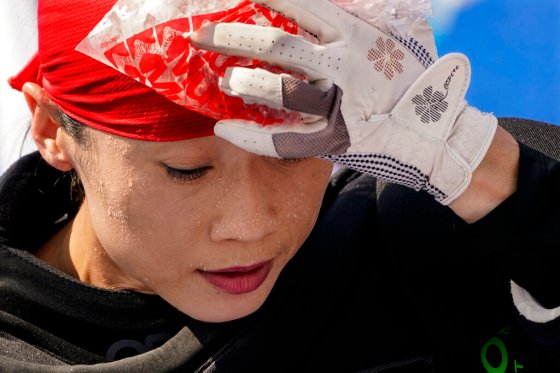
How hot is too hot?
The mean temperature in Tokyo has climbed by 2.9 degrees Celsius (5.1 degrees Fahrenheit) since 1900, more than three times as fast as the world’s average, according to a report by the British Association for Sustainable Sport. The study, titled “Rings of Fire: How Heat Could Impact the 2021 Tokyo Olympics,” says that athletes are being asked to compete in environments that are becoming “too hostile” for the human body as climate change increases global temperatures.
The 2004 Athens Olympics were the hottest since 1964, with a maximum daily temperature of about 93.6 degrees, according to the report. The last summer Olympics, in Rio, had a max daily temperature of just under 92 degrees.
With the Japan Meteorological Agency forecasting high temperatures of more than 93.2 degrees next week, this year’s Olympics will come close to hitting the record, and may surpass it.
READ MORE: Team USA Just Had Its Biggest Day Yet in the Pool. And Caeleb Dressel Clinched the Marquee Gold
Brandon Aydlett, a lead meteorologist with the National Weather Service office in Guam, tells TIME that athletes won’t find much relief in the coming days. “When you have weak winds across the area that really makes the heat feel more oppressive, and also that humidity will become a little bit more burdensome on people.”
Maloney, of the Tokyo Heat Project, tells TIME that heat and humidity can have a significant impact on performance. “It’s not uncommon for athletes to experience a reduction in performance of up to 10%, especially if they arrive unprepared and unacclimated.”
She says that competing in high humidity can be particularly difficult, because as humidity rises, it becomes more challenging for the sweat to evaporate from the skin. “If the sweat simply drips off the body, it has no cooling effect and contributes to dehydration and a continual rise in body temperature,” she says.
July and August are the hottest months in Japan, and the last summer Olympics in the country in 1964 were held in October. Japan has faced criticism for describing the country’s weather “mild” and “ideal” during the bidding process; especially since Tokyo’s heat has proved deadly in past years. A heatwave in the summer of 2018 killed more than 1,000 people. In the last week of July 2019, dozens died and thousands were hospitalized. Last summer, Hamamatsu, a coastal city in Shizuoka Prefecture on the island of Honshu, tied a national temperature record of 106 degrees.
And, though it may be cold comfort, the heat athletes face is line with annual averages for Tokyo.
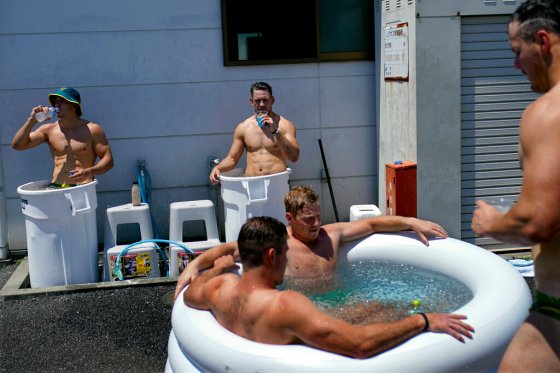
‘I can finish the match, but I can die’
The impact of the heat has been hard to miss for anyone watching the Olympics closely. At the Opening Ceremony, some athletes could be seen laying in the humidity on the stadium floor during the Parade of Nations, checking phones, seemingly exhausted after just walking through the stadium.
On the day of the Opening Ceremony, Russian archer Svetlana Gomboeva collapsed from heatstroke (she recovered to win a silver medal).
Spanish tennis player Paula Badosa left the court in a wheelchair on Wednesday after retiring from her quarterfinal match against Marketa Vondrousova, the Czech player who knocked Naomi Osaka out of the Games, because of heatstroke. A Russian player struggled to play in the hot and humid conditions (the heat index felt like it was about 99 degrees.) “I can finish the match but I can die,” Daniil Medvedev told an umpire, who asked if he could continue play.
After Medvedev, world No. 1 Novak Djokovic and other players lobbied for changes, the International Tennis Federation announced that beginning on Thursday, tennis matches would start at 3 p.m. local time instead 11 a.m. to protect athletes from the hottest part of the day.
Tennis players may be some of the most at risk athletes. The British Association for Sustainable Sport report cited tennis, hockey, triathlon and marathon—all requiring long exposure to the elements—as sports with a high risk of heat-related illness. In a concession to the heat, marathon and race walking events were moved some 500 miles north of Tokyo to the island of Hokkaido.
Read more about the Tokyo Olympics:
- Naomi Osaka: ‘It’s O.K. to Not Be O.K.’
- Motherhood Could Have Cost Olympian Allyson Felix. She Wouldn’t Let It
- Simone Biles’ Olympic Team Final Withdrawal Could Help Athletes Put Their Mental Health First
- ‘Unapologetic and Unafraid.’ Sue Bird Stares Down Olympic Glory in Tokyo and Equity Off the Court
- Meet 6 Heroes Who Helped Battle COVID-19 Before Competing in the Tokyo Olympics and Paralympics
- Here’s How Many Medals Every Country Has Won at the Tokyo Summer Olympics So Far
- 48 Athletes to Watch at the Tokyo Olympics
- The Olympic Refugee Team Was Created to Offer Hope. Some Athletes Are Running Away From It
In 2019, organizers of the Games launched the Tokyo 2020 Cooling Project to address the weather—proposing solutions like installing mist cooling stations and offering frozen desserts. A volunteer on the press operations team tells TIME that they’ve set up a shift system so she only needs to work outside for an hour at a time.
Athletes and onlookers are using a host of tricks to stay cool. Several athletes from Team Canada who came to watch the women’s street skateboarding event on July 26 brought a bag of ice along to keep themselves cool. One reporter covering skateboarding covered his head with an umbrella, as protection from the sun. Team USA flag bears wore battery-powered cooling jackets designed by Ralph Lauren to the Opening Ceremony.
Kayaker Brigden-Jones plans to try to stay in air conditioning between races, and use things like ice vests and baths and cold drinks to keep cool. Given the short length of her races (less than two minutes), she says she isn’t too worried about the heat.
Maloney cautions that coaches and others may also be at high-risk of suffering from heat. “It’s often the support staff and coaches that end up being out in the heat for the longest and are potentially less concerned with themselves,” she says.
Maloney says that prior heat acclimation is particularly important. “Without adequate preparation, athletes put themselves at greater risk of heat-related illness,” she says, “especially given we know athletes are highly motivated and willing to push themselves to the limit.”
—With reporting by Sean Gregory and Aria Chen/Tokyo.

Israel investigating shooting of Palestinian boy in West Bank
Palestinian officials say soldiers shot the 12-year-old as he travelled in a car in the West Bank.
from BBC News - World https://bbc.in/3l62Mov
from BBC News - World https://bbc.in/3l62Mov
Global education summit targets pandemic-hit schooling
A summit in London is raising aid to support 175 million children in the poorest countries.
from BBC News - World https://bbc.in/2URFRTr
from BBC News - World https://bbc.in/2URFRTr
Bob Odenkirk: Better Call Saul actor 'stable' after 'heart-related incident' during filming
The US actor is still in hospital after being rushed there from the set of Better Call Saul.
from BBC News - World https://bbc.in/3f9mEU2
from BBC News - World https://bbc.in/3f9mEU2
Wednesday, July 28, 2021
He Tried to Walk on Water From Florida to New York. It Didn’t Go So Well.

By Neil Vigdor from NYT U.S. https://nyti.ms/3BVbfAT
Katie Ledecky crushes the first women’s 1,500-meter freestyle at the Olympics.

By Matthew Futterman from NYT Sports https://nyti.ms/2VfDpWv

South Africa riots: The inside story of Durban's week of anarchy
The worst unrest since white-minority rule ended has left deep scars, especially in the coastal city of Durban.
from BBC News - World https://bbc.in/3rErqxT
from BBC News - World https://bbc.in/3rErqxT
Why cannabis is still a banned Olympics substance
US sprinter Sha'carri Richardson won't compete due to a positive marijuana test. People are asking why.
from BBC News - World https://bbc.in/2V2YfIR
from BBC News - World https://bbc.in/2V2YfIR
Gaza photographer hopes digital art boom can help raise aid money
A Palestinian photographer wants to help children by selling an image from May's conflict.
from BBC News - World https://bbc.in/3iWQDQi
from BBC News - World https://bbc.in/3iWQDQi
Covid vaccines: Tourists head to the US to get vaccinated
Some tourists are spending thousands of dollars to travel to the US to get a coronavirus vaccine.
from BBC News - World https://bbc.in/3iTeAI6
from BBC News - World https://bbc.in/3iTeAI6
Arthur: Popular children's show to end after 25 years
US public broadcaster PBS confirmed the final episode will air in winter 2022.
from BBC News - World https://bbc.in/3rDA0gc
from BBC News - World https://bbc.in/3rDA0gc
Colorado officer arrested after threatening to shoot suspect during stop
The Colorado officer was filmed striking a man with his gun, saying "if you move, I will shoot you".
from BBC News - World https://bbc.in/3BLt59D
from BBC News - World https://bbc.in/3BLt59D
Dusty Hill: ZZ Top founding bassist dies aged 72
Dusty Hill played bass for the iconic US blues rock band for more than five decades.
from BBC News - World https://bbc.in/3f96dHs
from BBC News - World https://bbc.in/3f96dHs
Bosnian Serbs defy top UN official Inzko over genocide denial
Ethnic Serb leaders, accused of playing down the Srebrenica massacre, will now boycott parliament.
from BBC News - World https://bbc.in/3j02FZ0
from BBC News - World https://bbc.in/3j02FZ0
Teodoro Nguema Obiang Mangue and his love of Bugattis and Michael Jackson
Teodoro Nguema Obiang Mangue, tipped as Equatorial Guinea's next leader, is under sanctions in the UK and France.
from BBC News - World https://bbc.in/3xgSR28
from BBC News - World https://bbc.in/3xgSR28
Pedro Castillo: The primary school teacher who became Peru's president
The meteoric rise of leftist Pedro Castillo has shaken Peru's political and business elite.
from BBC News - World https://bbc.in/3zMoIJq
from BBC News - World https://bbc.in/3zMoIJq
Remington: US gunmaker offers $33m to Sandy Hook shooting victims
Victims' families from Sandy Hook elementary school sued Remington for the sale of the rifle.
from BBC News - World https://bbc.in/3ynotUM
from BBC News - World https://bbc.in/3ynotUM
Man on scooter steals millions from upmarket Paris jeweller
The middle-aged armed robber targets a store in an upmarket area of the French capital.
from BBC News - World https://bbc.in/3i98lAC
from BBC News - World https://bbc.in/3i98lAC
Shamook: Star Wars effects company ILM hires Mandalorian deepfaker
The artist, who uses the online alias Shamook, has been recruited by Industrial Light and Magic.
from BBC News - World https://bbc.in/2TFqX1P
from BBC News - World https://bbc.in/2TFqX1P
She Changed Astronomy Forever. He Won the Nobel Prize for It.

By Ben Proudfoot from NYT Opinion https://nyti.ms/3f3e5Kg
Tanzania's Samia Suluhu Hassan gets Covid jab in policy reverse
After the Covid scepticism of her predecessor, Tanzania's President Samia launches a vaccine campaign.
from BBC News - World https://bbc.in/3l6woC7
from BBC News - World https://bbc.in/3l6woC7
Simone Biles is withdrawing from the Olympic all-around gymnastics competition.

By Juliet Macur from NYT Sports https://nyti.ms/3iVjp3I
Sweden charges man over 1988 Iran prison massacre
Hamid Nouri faces trial over the mass execution of detainees during the Iran-Iraq war.
from BBC News - World https://bbc.in/3i65FUC
from BBC News - World https://bbc.in/3i65FUC
Bob Odenkirk: Better Call Saul star collapses on set of Breaking Bad spin-off
The US actor was reportedly rushed to hospital in Los Angeles after being taken ill in New Mexico.
from BBC News - World https://bbc.in/2VePuLM
from BBC News - World https://bbc.in/2VePuLM
Tokyo Olympics: Why 'superhuman' Simone Biles could change attitudes to mental health in sport
Athletes discuss Simone Biles' decision to prioritise her mental health at the Tokyo Olympics and how she could change attitudes in sport.
from BBC News - World https://bbc.in/3BSfn4A
from BBC News - World https://bbc.in/3BSfn4A
China building nuclear missile silo field, scientists say
A new report based on high-quality satellite images says the site could hold up to 100 silos.
from BBC News - World https://bbc.in/3l93AZR
from BBC News - World https://bbc.in/3l93AZR
Tuesday, July 27, 2021
Roma student: 'My only goal is to finish school'
How one school in Croatia is working to improve education opportunities for Roma children like Kristina.
from BBC News - World https://bbc.in/3iUasYl
from BBC News - World https://bbc.in/3iUasYl
Tokyo Olympics: German gymnasts' full-body suits inspire other athletes
British-Jamaican gymnast Danusia Francis believes athletes should have a choice over their outfits.
from BBC News - World https://ift.tt/2WnySSp
from BBC News - World https://ift.tt/2WnySSp
Tokyo Olympics: Take a tour of the incredible venues
They range from an arena built by a father and son, to a legendary home of Japanese martial arts.
from BBC News - World https://bbc.in/2UUFFCO
from BBC News - World https://bbc.in/2UUFFCO
Ivory Coast president and rival in first meeting since civil war
President Alassane Ouattara and Laurent Gbagbo shook hands at the presidential palace on Tuesday.
from BBC News - World https://bbc.in/3i7BzQB
from BBC News - World https://bbc.in/3i7BzQB
Israel-Gaza conflict: Apparent war crimes committed, says rights group
Human Rights Watch accuses Israel and Palestinian militants of unlawful attacks in May's conflict.
from BBC News - World https://bbc.in/3rD6VBw
from BBC News - World https://bbc.in/3rD6VBw
Greece: Forest fire rips through area near Athens
About 300 firefighters, water-dropping planes and helicopters helped bring the blaze under control.
from BBC News - World https://bbc.in/3zHokMu
from BBC News - World https://bbc.in/3zHokMu
Capitol riot: Officers describe racial slurs at 6 January hearing
Four officers who fought Trump supporters on 6 January give evidence at the first day of an inquiry.
from BBC News - World https://bbc.in/3l9W8gW
from BBC News - World https://bbc.in/3l9W8gW
Atlanta spa shootings: Georgia man pleads guilty
Robert Aaron Long, charged with killing eight people in March, says he murdered four of the victims.
from BBC News - World https://bbc.in/3zFuixd
from BBC News - World https://bbc.in/3zFuixd
New York City and California will require workers to be vaccinated or face testing.

By Emma Fitzsimmons, Sharon Otterman, Luis Ferré-Sadurní, Shawn Hubler, Daniel E. Slotnik and Dan Levin from NYT New York https://nyti.ms/3iTMKLR
Biles says mental health concerns led to pull out
Simone Biles says she "has to focus on her mental health" after pulling out of the gymnastics women's team final at Tokyo 2020.
from BBC News - World https://bbc.in/3l2GnZw
from BBC News - World https://bbc.in/3l2GnZw
Activision staff condemn firm's response to harassment claims
About 1,000 Activision Blizzard staff sign a letter describing managers' response as insulting.
from BBC News - World https://bbc.in/3rJSoEj
from BBC News - World https://bbc.in/3rJSoEj
The C.D.C. will recommend that some vaccinated people wear masks indoors again.

By Apoorva Mandavilli from NYT Health https://nyti.ms/3i7gvtj
Leverkusen blast: German chemical plant explosion leaves one dead
Officials in Leverkusen say four people are missing and 16 were injured in the blast on Tuesday.
from BBC News - World https://bbc.in/3f0PrKt
from BBC News - World https://bbc.in/3f0PrKt
Dad builds robotic 'exo-skeleton' to help son walk
The French robotics engineer said he was inspired to build the suit after his son asked him to.
from BBC News - World https://bbc.in/3y8XbSd
from BBC News - World https://bbc.in/3y8XbSd
Russia topped the United States for gold after Simone Biles’s stunning withdrawal.

By Juliet Macur from NYT Sports https://nyti.ms/3y8x2mu
As Virus Cases Rise, Another Contagion Spreads Among the Vaccinated: Anger

By Roni Caryn Rabin from NYT Health https://nyti.ms/3iTjVz9
Man in contraption washes up in Florida after trying to run on water
Reza Baluchi was trying to "run" 1,000 miles north, but ended up 30 miles south of his start point.
from BBC News - World https://bbc.in/3l1SgyA
from BBC News - World https://bbc.in/3l1SgyA
Britney Spears officially requests new conservator to replace her father
The star's new lawyer says her father's control of her career is "insane and depressing".
from BBC News - World https://bbc.in/3zH6b1m
from BBC News - World https://bbc.in/3zH6b1m
DaBaby's HIV and gay comments 'perpetuate discrimination'
The rapper made false claims about the life expectancy of people with HIV at a US festival.
from BBC News - World https://bbc.in/3iW26iQ
from BBC News - World https://bbc.in/3iW26iQ
Wright wins first ever Olympic surfing medal
Australian surfer Owen Wright marks his comeback from a traumatic brain injury by winning the first ever Olympic medal in surfing.
from BBC News - World https://bbc.in/3x20eKw
from BBC News - World https://bbc.in/3x20eKw

Rep. Clay Higgins, a staunch opponent of mask mandates, announces he and his family have Covid-19.

By Jonathan Weisman from NYT U.S. https://nyti.ms/2UWGStb
Beach handball: 'It's shocking to have to pay to not play in our pants'
Tonje Lerstad tells Newsbeat about a rollercoaster week for Norway's women's beach handball team.
from BBC News - World https://bbc.in/3zLjwWt
from BBC News - World https://bbc.in/3zLjwWt
Monday, July 26, 2021
Child Tax Credit Payments Have Begun. Should You Opt Out?

By Tara Siegel Bernard from NYT Your Money https://nyti.ms/3BJqGwc
Bezos' $2bn offer to get back in race to the Moon
The billionaire offers to pay $2bn in Nasa costs to be reconsidered for a key Moon lander contract.
from BBC News - World https://bbc.in/3kTU10S
from BBC News - World https://bbc.in/3kTU10S
Covid passports: How do they work around the world?
How are countries enforcing vaccine passports and what can people use them for?
from BBC News - World https://bbc.in/3vYla5R
from BBC News - World https://bbc.in/3vYla5R
US combat forces to leave Iraq by end of year
The move, while largely symbolic, could provide a domestic boost to both the US and Iraqi leaders.
from BBC News - World https://bbc.in/3zDtLvU
from BBC News - World https://bbc.in/3zDtLvU
Tunisia President Kais Saied accused of coup amid clashes
Months of tensions over Covid and the economy culminates in the sacking of the prime minister.
from BBC News - World https://bbc.in/3y2vevc
from BBC News - World https://bbc.in/3y2vevc
Nikola Tesla: Sparks fly over plans to honour inventor with coin
Both Croatia and Serbia claim Nikola Tesla, pioneer of alternating current electricity, as their hero.
from BBC News - World https://bbc.in/371DsYB
from BBC News - World https://bbc.in/371DsYB
How US pullback in Iraq could benefit Iran
The withdrawal of remaining US combat troops could help Iran achieve its ambitions.
from BBC News - World https://bbc.in/3i4Feyw
from BBC News - World https://bbc.in/3i4Feyw
German lawyers wrangle over pensioner's WW2 tank in basement
The 84-year-old kept the vehicle in his basement, along with an anti-aircraft gun and a torpedo.
from BBC News - World https://bbc.in/3l1M8GC
from BBC News - World https://bbc.in/3l1M8GC
AKO Caine Prize: Meron Hadero named first Ethiopian winner
Judges praised Meron Hadero's short story The Street Sweep which ends in a "clever twist".
from BBC News - World https://bbc.in/3kVeToj
from BBC News - World https://bbc.in/3kVeToj
White House: US to maintain Covid foreign travel restrictions
The White House says current rules will remain due to rising cases and variant transmission.
from BBC News - World https://bbc.in/2VamQLB
from BBC News - World https://bbc.in/2VamQLB
Greece seeks spear fisher who killed famous seal
Kostis, a rare Mediterranean monk seal rescued as a pup, is killed by a spear gun.
from BBC News - World https://bbc.in/2UTdVyh
from BBC News - World https://bbc.in/2UTdVyh
Tokyo Olympics: German women's gymnastics team wears full-body suits
Germany's gymnasts wear full-body suits in women's qualification at the Olympics as they continue their stand against the sexualisation of their sport.
from BBC News - World https://bbc.in/3kTUZu0
from BBC News - World https://bbc.in/3kTUZu0
After Covid Diagnosis, a Conservative Radio Host Sends a New Message

By Hamilton Matthew Masters and Giulia Heyward from NYT U.S. https://nyti.ms/3iNsmfi
New world news from Time: The Tokyo Olympics’ Newest Stars Are Two 13-Year-Old Skateboarders
Skateboarding’s newest stars are two 13-year-old girls.
Japan’s Momiji Nishiya, 13, made history on Monday when she took home the first women’s street skateboarding Olympic gold medal at the Tokyo 2020 Games. Standing next to her on the Olympic podium was Rayssa Leal from Brazil, also 13, who earned silver in the event. Japanese skater Funa Nakayama, 16, took bronze.
Nishiya’s win comes one day after 22-year-old Japanese skater Yuto Horigome won gold in the men’s event, and it cements Japan’s status as a skateboarding powerhouse.
The women’s skateboarding final was a huge moment for these Games—as some of the Olympics’ youngest competitors offered up impressive tricks and brutal wipeouts on an international stage.
[time-brightcove not-tgx=”true”]
Half of the skaters in the finals lineup were under 18, and in Tokyo’s scorching heat, they were determined to land their best tricks. They managed to fill the mostly empty skatepark with joy as hip-hop thumped in the background. The skaters were generous with hugs and applause after impressive runs. Margielyn Didal of the Philippines gave Japan’s Aori Nishimura fist pumps. Nakayama and Nishiya chatted with each other while waiting for their turns. Leal would sometimes skate near the spectator area, where the press and athletes were sitting to celebrate her high scores.
The few spectators at the Ariake Urban Sports Park witnessed some big surprises on Monday. World No. 1-ranked Pamela Rosa, 22, was seen as Brazil’s most likely medal hopeful, but she didn’t even make it to the final. Nishimura, 19, the No. 3-ranked female street skateboarder after claiming a world title in June at the Street Skateboarding World Championships, came in eighth after falling several times.
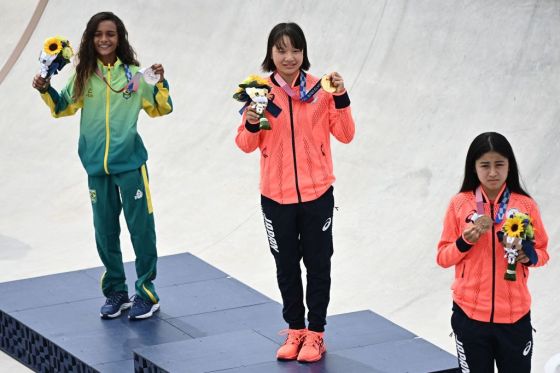
READ MORE: Japan’s Yuto Horigome Is the New King of Skateboarding
After winning gold, Nishiya was asked what she wanted to tell young skaters. “Skateboarding is fun and interesting, I hope everyone can give it a try,” she told TIME.
And this young field is already offering powerful inspiration for a new generation of skaters. Outside of Ariake Urban Sports Park, 9-year-old Keito Ota and 8-year-old Ayane Nakamura were eagerly waiting to catch a glimpse of the newly minted Japanese medalists. The two friends had started skateboarding about a year ago and arrived at the park wearing Team Japan skateboarding shirts. Every time a bus left the venue, they would press themselves against the metal fences holding pieces of paper that said “Thank you for your hard work” and “Congratulations on your gold medal.”
Ota said he was already a fan of Horigome as well as Nishimura. But now he’s adding Nishiya and Nakayama to his list of favorite skateboarders. “I am their fan now,” Ota said as he slid around on his skateboard. In August, Ota will enter his first competition at a local skateboarding student cup.
Nishiya, 13 years and 330 days, is Japan’s youngest ever gold medalist, and one of the youngest in Olympics history. That record, though, goes to American diver Marjorie Gestring, who took the gold medal at the 1936 Berlin Games at the age of 13 years and 267 days. Leal, age 13 years and 203 days, would have set a new record had she finished first.
Japan’s big wins in the first two skateboarding events should hopefully change the nation’s perception about skateboarders and further cultivate its skating culture. Many Japanese still view skateboarding negatively. A “skating-banned” sign hangs just outside the Olympic skating venue in Tokyo.
Skateboarders across Japan are likely to have another big moment when the women’s park skateboarding event takes place Aug. 4. Japan’s Misugu Okamoto and Sakura Yosozumi, the world’s two top-ranked female park skaters, are strong contenders. Kokona Hiraki, Japan’s youngest Olympian who landed solid attempts at a Dew Tour event in May, could rewrite history at 12 years old.
As for Nishiya, who always gets rewards from her mother after competitions, told reporters she now just looks forward to getting yakiniku, Japanese-style grilled meat.
Read more about the Tokyo Olympics:
- Naomi Osaka: ‘It’s O.K. to Not Be O.K.’
- Motherhood Could Have Cost Olympian Allyson Felix. She Wouldn’t Let It
- ‘Unapologetic and Unafraid.’ Sue Bird Stares Down Olympic Glory in Tokyo and Equity Off the Court
- Meet 6 Heroes Who Helped Battle COVID-19 Before Competing in the Tokyo Olympics and Paralympics
- 48 Athletes to Watch at the Tokyo Olympics
- The Olympic Refugee Team Was Created to Offer Hope. Some Athletes Are Running Away From It

Tunisia: Key moments as political turmoil unfolds
Tunisia's president sacks the PM and the speaker is barred entry to parliament following violent protests.
from BBC News - World https://bbc.in/3BKGYVi
from BBC News - World https://bbc.in/3BKGYVi
5 Dead in Hamptons Crash That Is Blamed on Speeding

By Ashley Southall from NYT New York https://nyti.ms/2WnvRBJ
US accused of demonising China in high-level talks
US Deputy Secretary of State Wendy Sherman is the most senior official to visit under Mr Biden.
from BBC News - World https://bbc.in/3x5gfPO
from BBC News - World https://bbc.in/3x5gfPO
Sandstorm swallows city in northwestern China
Dust clouds towered at least 100 metres (330ft) over Dunhuang.
from BBC News - World https://bbc.in/3eWyrVQ
from BBC News - World https://bbc.in/3eWyrVQ
Facebook’s Next Target: The Religious Experience

By Elizabeth Dias from NYT U.S. https://nyti.ms/3i7flOJ
Broadcaster Apologizes for ‘Inappropriate’ Images Aired During Olympic Parade

By Neil Vigdor from NYT Sports https://nyti.ms/3iHgFXy
New world news from Time: Tensions in Tunisia After President Suspends Parliament
TUNIS, Tunisia — Troops surrounded Tunisia’s parliament and blocked its speaker from entering Monday after the President suspended the legislature and fired the Prime Minister following nationwide protests over the country’s economic troubles and coronavirus crisis.
Protesters celebrated President Kais Saied’s decision late Sunday night with shouts of joy, honking horns and waving Tunisian flags. But his critics accused him of a power grab that threatens Tunisia’s young democracy, and the North African country’s overseas allies expressed concern.
Police intervened Monday to prevent clashes outside the parliament building between lawmakers from Islamist party Ennahdha, which dominates the Assembly of the Representatives of the People of Tunisia, and demonstrators supporting the President. Both sides shouted and some stones were thrown, according to an Associated Press reporter and videos circulating online.
[time-brightcove not-tgx=”true”]
Security forces also moved in Monday on the Tunis offices of broadcaster Al Jazeera, ordering it to shut down, according to a statement by the Qatar-based network on its Facebook page. The reason for the move was not immediately clear.
The dissolution of parliament had been among demands of thousands of protesters who defied virus restrictions and scorching heat to demonstrate Sunday in the capital, Tunis, and other cities. The largely young crowds shouted “Get out!” and slogans calling for early elections, and also pushed for economic reforms. Clashes erupted in many places.
The President said he had to fire the Prime Minister and suspend parliament because of concerns over public violence.
“We have taken these decisions…until social peace returns to Tunisia and until we save the state,” he said in a military-style televised address.
The parliament speaker, Ennahdha party leader Rached Ghannouchi, tried to enter parliament overnight but police and military forces guarding the site stopped him. On Monday morning, Ghannouchi was parked in a car in front of the building. His next steps were unclear.
He called the President’s move “a coup against the constitution and the (Arab Spring) revolution,” and insisted the parliament would continue to work.
Saied defended his decision, saying in a statement Monday that he acted according to the law.
Saied visited protesters overnight on the capital’s main thoroughfare, Avenue Bourguiba, the epicenter of mass demonstrations that pushed out Tunisia’s autocratic leader in 2011 and ushered in uprisings around the Arab world.
He warned against any breach of public order, threatening severe penalties.
The President invoked an article of Tunisia’s Constitution allowing him to take “exceptional measures in the event of imminent danger threatening the institutions of the nation and the independence of the country and hindering the regular functioning of the public powers.”
The measure allows him to assume executive power and freeze parliament for an unspecified period of time until normal institutional workings can be restored. But Ghannouchi said the President didn’t consult with him and the Prime Minister as required by the article. The three have been in conflict.
Read more: Tunisia’s Fledgling Democracy Shows Signs of Wear and Tear
Others also criticized the president’s decision, both inside and outside Tunisia.
Former President Moncef Marzouki called for political dialogue, saying in a Facebook video, “We made a huge leap backward tonight, we are back to dictatorship.”
In a written statement, EU Commission spokesperson Nabila Massrali said Monday, “We call on all Tunisian actors to respect the Constitution, its institutions and the rule of law. We also call on them to remain calm and to avoid any resort to violence in order to preserve the stability of the country.”
Turkey’s government said it was “deeply concerned” by the suspension of the Tunisian parliament’s activities and said it hoped that “democratic legitimacy” is soon restored.
A Turkish Foreign Ministry statement called Tunisia an “exemplary success story in terms of the democratic process” and said it was imperative that its “democratic achievements” are preserved. Tunisia’s 2011 revolt is often regarded as the only success story of the Arab Spring protests.
___
Mehdi El Arem in Tunis, Jon Gambrell in Dubai, Lorne Cook in Brussels and Suzan Fraser in Ankara contributed to this report.

Maharashtra: How one city avoided worst of India floods
At least 149 people have died across the Indian state this monsoon season.
from BBC News - World https://bbc.in/2UIQEPM
from BBC News - World https://bbc.in/2UIQEPM
Pink offers to pay bikini bottoms fine for Norway women's handball team
The Norway women's side were last week fined for wearing shorts instead of bikini bottoms in a match.
from BBC News - World https://bbc.in/2TDptFq
from BBC News - World https://bbc.in/2TDptFq
Sunday, July 25, 2021
Is That Stroller in the Hallway Really a Safety Hazard?

By Ronda Kaysen from NYT Real Estate https://nyti.ms/3eVD5Db
New Zealand to allow IS-linked mother to be repatriated
Permission for a mother and her children to travel was not taken lightly, NZ prime minister says.
from BBC News - World https://bbc.in/3iKDwkV
from BBC News - World https://bbc.in/3iKDwkV
New world news from Time: Battered by a Surge in COVID-19 Cases, Thailand’s Health System Is Relying on Volunteers to Plug the Gaps
BANGKOK, Thailand — As Thailand‘s medical system struggles beneath a surge of coronavirus cases, ordinary people are helping to plug the gaps, risking their own health to bring care and supplies to often terrified, exhausted patients who’ve fallen through the cracks.
In the Samai area of Bangkok, Ekapob Laungprasert’s team heads out for another weekend on the front lines of a crisis.
His volunteer group, Samai Will Survive, has been working around the clock, responding to about a hundred SOS calls daily from desperate COVID-19 patients unable to get the help they need.
“We realize how hard working and how tired doctors and nurses are,” says the 38-year-old businessman. “What we are trying to do today is to help relieve some of the burden. Before, all cases must go to the hospital, so today there are no hospital beds. So we volunteer to help out.”
[time-brightcove not-tgx=”true”]
It’s not long before they’re in action: Malee, a COVID-19 positive woman whose breathing has suddenly worsened. The group, wearing personal protective equipment, delivers oxygen and much-needed reassurance to Malee and her husband, an army officer who also has the virus.
“I lost hope even with the army. I called doctors at field hospitals. All they told me to do was to send information, just send information,” Worawit Srisang said. “I got the same answers everywhere. At least these guys visit us in person. What the patient needs is a chance to see a doctor, not just send information.”
Thailand’s predicament is stark. Around 15,000 new cases are confirmed each day and still more people are getting infected. In Bangkok alone, 20,000 people are waiting for a hospital bed.
So homespun heroes like Ekapob and his group — buying equipment and supplies with public donations — are an essential safety net, gaining crucial time for both patients and a health care system under severe strain.
There’s another call: an elderly woman with COVID-19 symptoms. But she’s not fit to wait in line for hours at an overwhelmed test center, so for the moment she’s stuck where she is.
“Grandma can’t get tested, so she lies sick in bed. If we want to send her to the hospital, they will ask for her test result. So we are back in a circle, because we would ask them to do the test,” Ekapob says, looking in through the window.
It’s very likely she has COVID-19. All her family members have already tested positive.
After a check, his team members decide she’s not in imminent danger. They hook her up with oxygen, then it’s back into the night and on to the next case.
There’s a raging debate in Thailand now over the national vaccination roll-out. Many Thais are angry over the slow pace and a perceived lack of accountability for the fact that only around 5% of the population currently is fully protected.
The volunteers see the consequences almost every night.
They’re called to 52-year old Nittaya Kongnuch, who like so many is struggling to breathe normally.
As they try to make her more comfortable, her sister tells an increasingly familiar story. Their mother died last week from the virus, as their urgent calls for help to brimming hospitals went unheeded.
“My mother showed bad symptoms from the beginning. I called and called to tell them my mom couldn’t handle this anymore, but nobody came. The nurses kept saying there were no beds,” said Piyawan Kodduang, fighting back tears.
Most fatalities occur in private. But not all. Last week, a body lay for hours in a Bangkok street, incurring the wrath of an embarrassed prime minister.
On Saturday night, Ekapob and his team see exactly how that can happen, as they’re called to a homeless woman who’s showing signs of infection.
As wary residents watch from a distance, the team moves in to carry out a rapid test.
Within a few minutes they have the result: positive.
After making some phone calls, Ekapob finds her a place in a facility where she can be observed while awaiting a bed in a field hospital.
At least she has a fighting chance. Without the volunteers, it’s likely she wouldn’t have any.
Thailand has had 497,302 cases of COVID-19 and 4,059 deaths since the pandemic began.

New world news from Time: China Sends Supplies to Devastated Areas After Flooding Kills at Least 63
XINXIANG, China — Trucks carrying water and food on Sunday streamed into a Chinese city hit hard by flooding that killed at least 63 people, while soldiers laid sandbags to fill gaps in river dikes that have left neighborhoods under water.
Residents cleared away mud, wrecked cars and other debris after record rains that started Tuesday and flooded streets and disrupted train service in Henan province. The rains have subsided, but some neighborhoods were still waiting for water up to two meters (six feet) deep to drain.
The provincial government raised the death toll to 63 on Sunday, with five people missing, state TV reported. It said 8,876 homes had collapsed.
[time-brightcove not-tgx=”true”]
Trucks dropped off instant noodles and other goods at a stadium in Xinxiang, 40 miles (65 kilometers) north of the Zhengzhou, the provincial capital. Volunteers shifted pallets of drinking water stacked higher than their heads onto other trucks for distribution, occasionally breaking into cheers of, “Go, Xinxiang!”
The city was hit as the rains moved north from Zhengzhou, where flash floods killed more than 50 people, including 12 in the inundated subway system.
Business owner Han Yuan and her employees loaded boxes of disinfectant onto a truck for delivery to the city’s Fengquan district, one of the worst-hit areas. “This is the city that raised me, and every one of us is devoting all we have to protect this city,” she said.
Three military helicopters were used to bring drinking water, medicine, food and other relief items to about 20,000 people in inaccessible areas, including Xinxiang’s Hongzhou and Yuhe townships, the official Xinhua News Agency said.
Direct economic losses throughout Henan were estimated at 13.9 billion yuan ($2 billion), Xinhua reported. It said more than 1.1 million people had been relocated to safer areas.
Lu Qinghan, the owner of a recycling station, estimated she lost 30,000 to 40,000 yuan ($4,700 to $6,200), at least one third of her annual income, after floods washed away some of the station’s waste material.
Her family got power back Sunday evening, but still needed clean water. Fengquan district residents lined up to register at a relief station for bottles of water.
“When (the flooding) was at its most severe, there was no electricity, and I couldn’t see anything,” Lu said. “When I smelled something different, the water was already reaching my bed.”
Emergency crews were trying to close gaps in flood dikes that flooded sections of villages.
Soldiers and paramilitary police dumped stones and sandbags into a 100-meter-long (300-foot-long), eight-meter-deep (25-foot-deep) gap on the Weihe river in Xinxiang, the state-owned Global Times newspaper reported.
On Saturday, authorities intentionally had flooded parts of the nearby city of Hebi to lower water levels elsewhere, according to Shanghai online news outlet The Paper.
In Xinxiang, Zhang Meirong said she was so moved when people from Heze city in neighboring Shandong province came to help that she asked her daughter to take photos of them.
“I couldn’t feel more touched,” she said. “I didn’t have much education, and I couldn’t express it too well, but it’s all in my heart.”
___
Associated Press news assistant Caroline Chen contributed.

Tunisia PM sacked after violent Covid protests
Protesters clashed with police as they demanded the government be dismissed over Covid failings.
from BBC News - World https://bbc.in/3l0TIBz
from BBC News - World https://bbc.in/3l0TIBz
Triathlon gold goes to Norway at Tokyo 2020
Great Britain's Alex Yee wins silver in a punishing men's triathlon at the Tokyo Olympics as Kristian Blummenfelt of Norway claims gold.
from BBC News - World https://bbc.in/3eWmHCr
from BBC News - World https://bbc.in/3eWmHCr
Deadly street protests over Iran water shortages
Khuzestan is one of the country's hottest regions, where temperatures can reach 50C.
from BBC News - World https://bbc.in/2WlzUOU
from BBC News - World https://bbc.in/2WlzUOU
Unesco adds Madrid's Paseo del Prado and Retiro Park to heritage list
The famous Paseo del Prado and Retiro Park are symbols of the Spanish capital's history.
from BBC News - World https://bbc.in/2Wm3hk7
from BBC News - World https://bbc.in/2Wm3hk7
Nigerian outrage at brazen bandit attacks
The shooting down of a military jet shows how organised crime is becoming more daring by the day.
from BBC News - World https://bbc.in/3kPUJw6
from BBC News - World https://bbc.in/3kPUJw6
Tokyo Olympics: One athlete braved sharks and crocodiles
Training for the Olympics can be a full-time job but Jo Brigden-Jones has combined it with much more.
from BBC News - World https://bbc.in/3eWVcbX
from BBC News - World https://bbc.in/3eWVcbX
Covid-19: Recent claims about cremations and vaccines fact-checked
Debunking claims shared widely on social media about cremations in the UK and US vaccine statistics.
from BBC News - World https://bbc.in/3rM1wZj
from BBC News - World https://bbc.in/3rM1wZj
Afrobeats in Japan: British-Nigerian hip hop dancer teaching children how to dance
Yinka Oshiletu, a British-Nigerian hip hop dancer is bringing Afrobeats sounds to Japan's young dancers.
from BBC News - World https://bbc.in/3y4hwIo
from BBC News - World https://bbc.in/3y4hwIo
Covid: Fauci says US heading in wrong direction as cases rise
President Joe Biden's top medical adviser says cases are rising in areas with low vaccination rates.
from BBC News - World https://bbc.in/3yistWZ
from BBC News - World https://bbc.in/3yistWZ
Climate change: Israel to cut 85% of emissions by mid-century
PM Naftali Bennett says the decision will help the country gradually shift to a low-carbon economy.
from BBC News - World https://bbc.in/3zCi6x4
from BBC News - World https://bbc.in/3zCi6x4
Rockslide destroys bridge in northern India
It was one of several landslides in Himachal Pradesh on Sunday.
from BBC News - World https://bbc.in/2UPSY7n
from BBC News - World https://bbc.in/2UPSY7n
Large meteor wows Norway after blazing through night sky
The meteor is believed to have landed in a forest after flashes of light were seen across Norway.
from BBC News - World https://bbc.in/3rvyZHa
from BBC News - World https://bbc.in/3rvyZHa
Jackie Mason, rabbi turned comedian, dies aged 93
The famed US stand-up comedian and actor voiced Krusty the Clown's father in The Simpsons.
from BBC News - World https://bbc.in/3iKjdnQ
from BBC News - World https://bbc.in/3iKjdnQ
India landslide: Nine tourists killed as boulders fall from hilltop
A vehicle carrying tourists from Delhi is struck by large rocks in the state of Himachal Pradesh.
from BBC News - World https://bbc.in/3zEpNmN
from BBC News - World https://bbc.in/3zEpNmN
Simone Biles starts Olympics with a floor exercise that isn’t up to her usual standards.

By Juliet Macur from NYT Sports https://nyti.ms/3i31HMv